


On Saturday, 10 October 2026, Archonet hosted a live webinar, Inside DCPR 33(9): Potential, Pitfalls & Practical Clarity. It was a developer-focused walkthrough of the Cluster Development Scheme under Mumbai’s DCPR 2034, led by our co-founders Mahek Chheda (CEO) and Viral Gala (COO). More than 100 people joined from development, investment, consulting and design teams, and the chat stayed busy right up to the last minute, so a good part of this recap comes straight from your questions. If you missed the session, here’s what we covered and the answers worth keeping.
If you’d rather watch than read, the full recording is here.
Table of Contents
Why 33(9) gets reduced to a one-liner
Ask a few developers what 33(9) is and you’ll usually hear the same thing: “the cluster scheme”, or CDS, followed by “more FSI if you have over an acre in the city or an acre and a half in the suburbs.” That’s roughly true. It’s also where a lot of feasibility work goes wrong, because the one-liner skips what actually decides whether a cluster works: what can go into it, how the FSI is built up, and what happens to the MHADA share.
Formally, 33(9) covers the reconstruction or redevelopment of cluster(s) of buildings under Cluster Development Scheme(s). In practice, a group of plots or buildings is redeveloped together as one project, with a rehab component for existing occupants and a sale component for the developer.
Here is how it sits next to the other common redevelopment routes, on an 18m road in the suburbs with 1 FSI utilised (excluding fungible):
| Scheme | Max FSI | Rehab / incentive / free balance | Paid / authority share |
|---|---|---|---|
| 33(7B) CHS redevelopment | 2.4 | 1.15 | 1.25 |
| 33(9) Cluster development | 4.0 | 3.37 | 0.63 |
| 33(11) PTC scheme | 4.0 | 2.5 | 1.5 |
| 33(19) Commercial scheme | 4.0 | 1.0 | 3.0 |
| 33(20B) AH / R&R scheme | 4.0 | 2.5 | 1.5 |
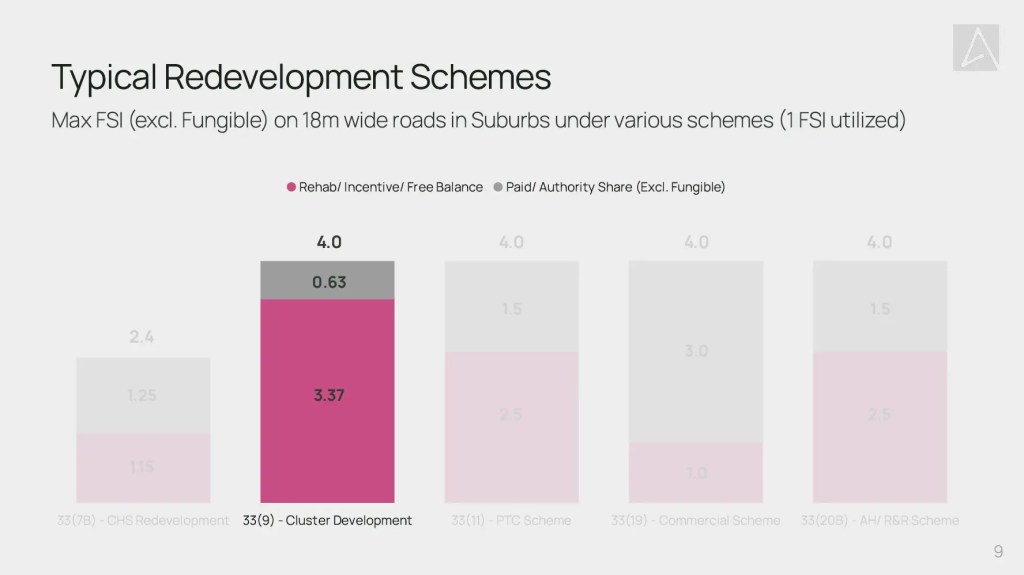
Of the four routes that reach 4.0, 33(9) has the smallest authority share. A word of caution though: the bigger number on the rehab and incentive side includes the rehab you have to deliver, so this is where the comparison starts, not where it ends.
Eligibility
Two gates decide whether a cluster qualifies at all: plot size and road width.
- Plot area: minimum 4,000 sq.m. in the City, 6,000 sq.m. in the Suburbs
- Road width: minimum 18m, or 12m if an 18.3m arterial road exists within 500m
The next question is what you’re allowed to put in the cluster:
- Cessed buildings (MHADA Act, 1976)
- MHADA buildings aged 30 years or more
- Authorised buildings aged 30 years or more
- Unsafe buildings certified by MHADA or MCGM
- Vacant or public land, with prior permission
- Slums, up to 50% of the cluster area
A few answers from the live chat:
- Multiple wings of one society: yes, as long as there is more than one building and the plot meets the criteria. Whether the wings are structurally connected doesn’t matter. Plot area and accessible road width decide.
- MHADA layouts: 33(9) can be done on a MHADA layout.
- Shops and other non-residential: no additional area. The entitlement is the existing area or 20.90 sq.m., whichever is more.
- Road width: 18m is the minimum, per the slide above.
We also put a poll to the room: four plots totalling 8,500 sq.m., abutting an 18.3m road, with 5,000 sq.m. of it under slum. Is 33(9) applicable? Run the slum cap against it. Slum land is about 59% of the cluster, above the 50% ceiling, so as structured it doesn’t work. Bring in more non-slum land and the share drops.
How the FSI is built up
The headline numbers for 33(9), the same in the Island City and the Suburbs:
- Max FSI: the higher of 4.00 or Rehab + Incentive FSI
- Rehab area: basic carpet of at least 35 sq.m., plus an additional entitlement of up to 35%, with a cap on entitlement for units above 100 sq.m.
- Incentive: up to 130%, based on the LR/RC ratio and plot area
- Balance FSI (if any): up to 70% of the surplus is shared with MHADA
On the “35% carpet” question that came up in chat: carpet here means the net usable floor area within a tenement, excluding walls and any areas exempted from FSI under the prevailing regulation, but including balconies where those are allowed free of FSI.
Now put numbers on it. Take a base case where the existing buildings used 1 FSI:
- Protected (rehab) 1.35 + Incentive 1.75 + Balance FSI 0.90 + Fungible 1.40 = 5.40
And an over-utilised case where the existing buildings used 2 FSI:
- Protected 2.70 + Incentive 3.51 + Fungible 2.17 = 8.38
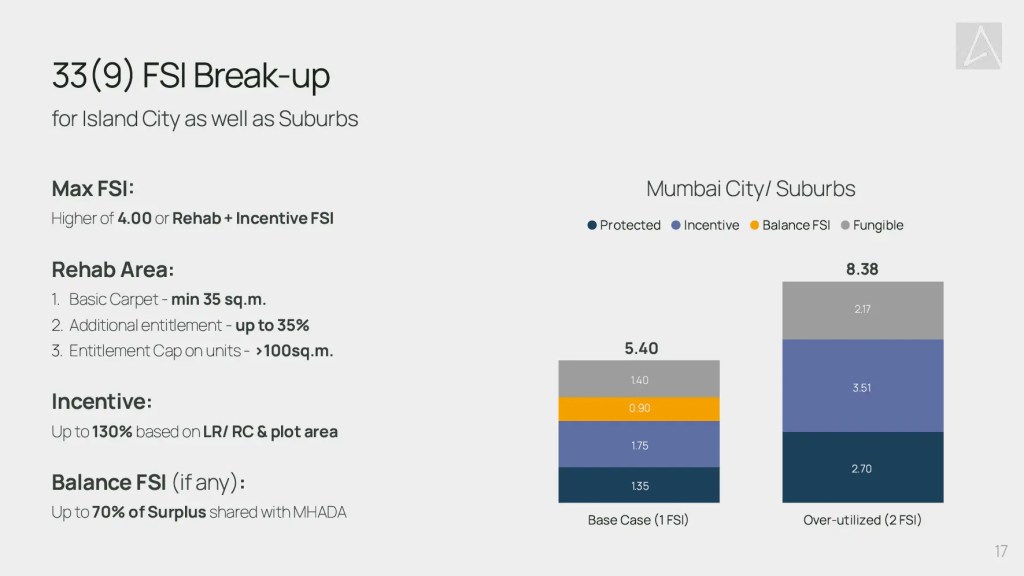
Look at the arithmetic and the logic shows. 1.00 of existing area becomes 1.35 after the 35% additional entitlement, and the 130% incentive on top of that gives roughly 1.75. Double the existing area and every layer doubles with it. That is why two clusters of the same size can behave so differently: what’s standing on the land today feeds straight into what you can build.
MHADA surplus
When there’s a balance FSI, up to 70% of the surplus goes to MHADA. That raises the practical question developers kept asking: do you build the MHADA share on the same plot (in-situ) or move it to another plot?
In our example, building it in-situ gives a total of 5.18 FSI, of which 0.63 is the MHADA share. Shift that 0.63 to another plot with a lower ASR and the main plot goes back to the full 5.40. Hence the learning that in-situ, your max FSI is below 5.4.
Two answers from the chat matter a lot here:
- No premium is payable for the ASR difference when the surplus is shifted to an area with a lower ASR. Viral confirmed this in the chat. It is a real contrast with the PTC and PAP clubbing under 33(11) and 33(20B), where unearned income kicks in.
- The ASR used is the land rate.
Shifting still isn’t free money. The revenue side is extra area × sale price. The cost side is the pro-rata MHADA area × the purchase price of those MHADA units, where:
Pro-rata MHADA area = MHADA surplus × ASR (main plot) ÷ ASR (other plot)
Here is the illustrative case we walked through, on the same ₹135 Cr investment:
| Parameter | Built in-situ | Shifted to other plot | Change |
|---|---|---|---|
| Max Permissible BUA | 35K sq.m. | 37.8K sq.m. | 8% |
| RERA sale area | 1.37 L sq.m. | 2.42 L sq.m. | +76% |
| MHADA surplus (purchase) | n/a | ₹355 Cr | n/a |
| Revenue | ₹1,035 Cr | ₹1,810 Cr | +75% |
| Total cost | ₹865 Cr | ₹1,400 Cr | +62% |
| Net profit | ₹170 Cr | ~₹405 Cr | ~+140% |
In this case shifting more than doubled the profit. But that depends on the ASR gap between the two plots and the price you pay for the MHADA units, so your numbers will differ. When we asked the room whether shifting is always beneficial, the honest answer was no. It depends on how the extra revenue compares with the extra cost.
Relaxations
33(9) also carries a set of relaxations that add up on a large cluster:
- LOS relaxed to 10% of the balance plot
- 10% LOS set-off against amenity
- Reduced marginal open spaces
- Passages up to 2m excluded from FSI
- No staircase premium on the rehab component
- Parking relaxed to 50%
Land parameters
Two land conditions regularly skew the workings.
Road or nalla setback. Under 33(9), max FSI is worked on the gross plot less the DP road setback, and the BUA on the setback is included in the rehab area. This came up four separate times in the chat, so it’s clearly a point of confusion. If you’re used to the 33(11) and 33(20B) workings from our earlier recaps, note the difference: there, max FSI runs on the gross plot without deducting the setback.
Plot falls in CRZ II. The maximum additional entitlement drops from 35% to 30%, and the maximum incentive from 130% to 100%. On a cluster that’s partly in CRZ II, that is a real dent in potential.
Still open
We didn’t get to everything. Several of your questions need more room than a live chat allows, and a few were asked more than once without a clean answer on the day:
- Do the plots in a cluster have to be contiguous? Can a plot across the abutting road, or a plot split by a municipal road, be included?
- The approval path: file movement, documents at each stage, timelines, the agencies involved, and the High Powered Committee (HPC) stage
- Premium calculation and concessions, and how 33(9) compares with 33(7B)
- How the MHADA component is arrived at, and whether it can be settled any other way than handing over units
- How construction rate is treated in the incentive
- Tenancy benefits where a tenanted building is demolished, and what happens to buildings under 30 years or tenements under 35 sq.m.
- Financing a cluster for a mid-sized developer
- Live examples, with file numbers
These are the topics we’re lining up for upcoming sessions and posts. The WhatsApp group below is the quickest way to hear about them.
Key learnings
- If MHADA surplus is built in-situ, max FSI is below 5.4.
- If the plot falls in CRZ II, the FSI and area calculations change.
- If MHADA surplus is shifted, the area you get increases pro-rata to the ASR.
- Shifting MHADA units increases revenue, but it also increases cost through the purchase price.
One more thing worth studying: when someone asked for a South Mumbai example of a 33(9) in practice, speakers pointed to One Avighna Park.
How LandWise helps
Working out which schemes apply to a plot, building the FSI statement for each, and pricing the approvals is where most feasibility time goes. LandWise, our software, gives you applicable schemes, the FSI statement and the approval cost in minutes, so you can compare routes like 33(9) against 33(11) and 33(20B) on the same plot. See how the 33(11) route works and how 33(20B) works if you want the full comparison.
Frequently asked questions
What is DCPR 33(9)?
Regulation 33(9) of DCPR 2034 covers the reconstruction or redevelopment of clusters of buildings under Cluster Development Schemes. Instead of redeveloping buildings one by one, a group of buildings or plots is redeveloped together, with a rehab component for existing occupants and a sale component. Cessed buildings, MHADA buildings and authorised buildings aged 30 years or more, certified unsafe buildings, vacant or public land (with prior permission) and slums (up to 50% of the cluster area) can all be part of it.
How much FSI can a cluster get under 33(9)?
Max FSI is the higher of 4.00 or Rehab + Incentive FSI. Rehab is a basic carpet of at least 35 sq.m. plus up to 35% additional entitlement, and the incentive goes up to 130% (100% in CRZ II). Any balance FSI is shared with MHADA, up to 70% of the surplus. In our base-case example with 1 FSI utilised, the total comes to 5.40 including fungible FSI.
What is the minimum plot area and road width for 33(9)?
The minimum plot area is 4,000 sq.m. in the City and 6,000 sq.m. in the Suburbs. The minimum road width is 18m, which comes down to 12m if an 18.3m arterial road exists within 500m.
Can MHADA surplus be shifted to another plot, and is a premium payable?
Yes, it can be built on another plot. Built in-situ, the example case reaches 5.18 FSI; shifted, the main plot gets the full 5.40. No premium is payable for the ASR difference when moving to a lower-ASR area, and the ASR used is the land rate. You do bear the cost of purchasing the MHADA units, calculated on the pro-rata area.
Can 33(9) be combined with other schemes or include slum land?
Slums can form up to 50% of the cluster area. On combinations, we were asked live whether 33(9) can be combined with 33(20B), and the answer was no.
Stay in the loop
Join the Archonet DCPR Learning Circle on WhatsApp for updates on future sessions and regulatory changes.
For more on LandWise, reach out to us at info@archonet.co.
Watch the full session here