

DCPR 33(20B) has become one of Mumbai’s most strategically important redevelopment pathways — yet most feasibility conversations still reduce it to a few familiar phrases: PAP rehousing, 4.05 FSI, 5.4 FSI, AH/R&R. The reality is far more layered. The scheme’s true power lies in how its FSI components, relaxations, clubbing options, and combination rules interact to reshape feasibility in ways developers often underestimate.
On July 18th, we hosted an in‑depth webinar breaking down these mechanics — from in‑situ vs clubbing to pro‑rata relaxations, to the financial impact of combinations. If you prefer a visual walkthrough of the concepts covered in this blog, you can watch the full session here
This article builds on that session and distills 33(20B) into a clear, structured deep dive — designed to help developers evaluate land more accurately, compare schemes more intelligently, and avoid the feasibility traps that quietly distort margins.
What 33(20B) Actually Is
DCPR 33(20B) is fundamentally a PAP rehousing and Affordable Housing (AH/R&R) scheme — but its real significance lies in how it enables redevelopment on private land and on authority‑owned land outside MCGM and Government ownership. This single distinction makes 33(20B) one of the few high‑FSI pathways available to private developers without relying on SRA or MHADA frameworks.
At its core, the scheme is designed to incentivize the creation of PAP/AH/R&R stock by granting developers a structured mix of PAP FSI and sale FSI. Unlike traditional rehabilitation schemes, 33(20B) does not require slum eligibility verification, does not involve SRA governance, and does not mandate ancillary components like Anganwadi. Instead, it operates through a cleaner, more predictable approval structure under MCGM.
Why 33(20B) Matters: The Redevelopment Gap It Fills
Mumbai has several redevelopment schemes, but very few offer meaningful residential potential on private land. Most developers evaluating feasibility today end up cycling through the same limited options:
33(7B): Primarily for CHS buildings, but with restricted FSI and limited flexibility. It works for legacy structures but rarely unlocks transformative redevelopment potential.
33(11): A widely used PTC rehousing scheme, but governed by SRA. While it offers predictable incentive, it also brings SRA‑specific compliance, ancillary area requirements, and constraints that reduce net sale potential on many parcels.
33(19): A commercial‑heavy scheme with limited residential applicability. It is powerful for office or mixed‑use projects but does not solve the residential redevelopment gap for private landowners.
Across these options, developers repeatedly encounter the same bottleneck: high rehab obligations, low sale potential, and restrictive governance frameworks.
This is where 33(20B) stands out.
Why 33(20B) is different — and increasingly preferred
33(20B) is one of the few schemes that:
- allows high residential FSI on private land,
- avoids SRA governance,
- offers cleaner compliance under MCGM,
- provides relaxations that materially improve feasibility,
- enables clubbing to unlock additional sale potential, and
- supports combinations with other schemes for even higher incentive.
Recent circulars — especially the 15 Oct 2024 GR and the 19 Mar 2025 procedural guidelines — have made the scheme even more lucrative by:
- expanding permissible combinations,
- clarifying pro‑rata relaxations,
- reducing ambiguity in premium applicability,
- easing LOS and parking requirements,
- and formalizing staircase/OSD concessions.
The result is a scheme that not only offers high FSI, but does so with predictability, flexibility, and clearer financial logic than most alternatives.
For developers evaluating residential redevelopment on private land, 33(20B) has become one of the most strategically important tools — especially when compared to the limited pathways available under 33(7B), 33(11), and 33(19).
Understanding the FSI Structure of 33(20B)
The scheme behaves differently depending on:
- road width,
- location (Island City vs Suburbs), and
- whether PAP is built in‑situ or clubbed elsewhere.
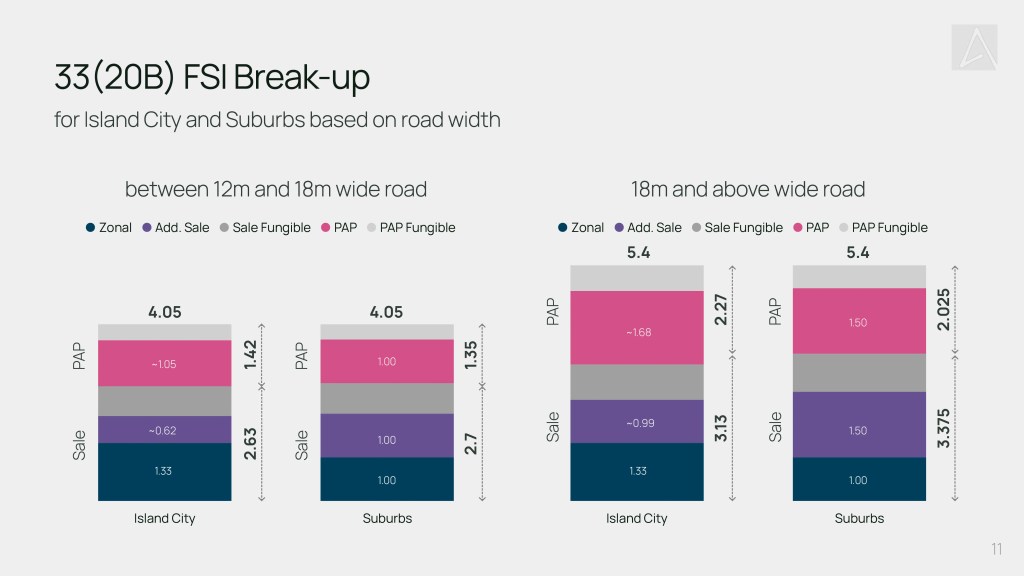
At its core, 33(20B) is a composite of:
- Zonal FSI
- Additional Sale FSI
- Sale Fungible FSI
- PAP FSI
- PAP Fungible FSI
The mix changes dramatically depending on the configuration. This is why two parcels with identical geometry can produce very different feasibility outcomes under 33(20B).
In‑Situ vs Clubbing: The Strategic Choice That Changes Everything
When PAP is built in‑situ, the scheme behaves in a predictable way. But when PAP is clubbed on another plot, the entire FSI structure shifts.
In‑situ PAP
You get a balanced mix of PAP + sale FSI on the main plot.
Clubbing PAP on another plot
You unlock higher sale potential on the main plot, but you also trigger:
- unearned income payments,
- PAP purchase costs,
- ASR‑based adjustments,
- pro‑rata relaxations, and
- additional compliance layers.
Clubbing increases revenue — but also increases cost. Developers who see only the revenue side misjudge feasibility.

The Financial Impact of Clubbing: Higher Sale, Higher Cost
Once PAP is moved off the main plot, the FSI composition shifts in a way that immediately increases sale potential. This is the primary reason developers explore clubbing — it unlocks more sale area on the main plot and improves topline revenue. But the financial story of clubbing is not one‑sided. Every additional square foot of sale comes with cost components that must be priced accurately.
Clubbing introduces three major financial effects:
1. Higher Sale Component on the Main Plot
By relocating PAP to another plot, the main plot becomes sale‑heavy. This increases revenue potential, improves project positioning, and often makes the feasibility look stronger at first glance. For parcels with high sale value, this uplift can be substantial.
2. Unearned Income Payment
The moment PAP is shifted to a plot with a lower ASR, unearned income gets triggered. This payment — calculated on the ASR difference between the main plot and the PAP plot — becomes a mandatory cost. It is one of the most commonly underestimated components in 33(20B) clubbing feasibility.
3. PAP Purchase Cost
Depending on the clubbing configuration, developers either purchase PAP units outright or pay a pro‑rata PAP cost. This cost is unavoidable and must be factored into feasibility alongside unearned income. In many cases, PAP purchase cost becomes the largest single expense in the clubbing pathway.
Together, these three components create a financial profile that is both lucrative and expensive. Clubbing increases revenue — but it also increases cost. Developers who evaluate only the sale uplift without accounting for unearned income and PAP purchase cost often misjudge viability.
This is why clubbing must be treated as a strategic decision, not an automatic upgrade. It works beautifully on certain parcels and becomes unviable on others. The feasibility depends entirely on how the revenue uplift compares to the layered cost structure beneath it.
Key Relaxations Under 33(20B)
33(20B) offers several regulatory relaxations that materially impact feasibility:
- Road setback relaxations (including for FSI calculation)
- LOS relaxed to 10% of balance plot
- Parking relaxed as per 33(11)
- OSD and staircase premiums at 10%
- Height limit under Regulation 43 not applicable
These relaxations often make 33(20B) as attractive as 33(11) or 33(9), but only when the cost structure aligns with the developer’s bidding strategy.
Land Parameters That Skew FSI Under 33(20B)
Two land conditions significantly alter feasibility:
Road Setback: Zonal FSI is calculated on gross plot minus setback, but maximum FSI is calculated on gross plot. This creates a mismatch developers often overlook.
CRZ II: If the plot falls in CRZ II, Zonal FSI as well as maximum FSI are calculated on gross plot minus setback, thereby reducing overall plot potential
These distortions can make two seemingly identical parcels behave very differently under 33(20B).
Once land‑based distortions are understood, the next layer of complexity comes from how 33(20B) behaves when combined with other schemes.
Combining 33(20B) With Other Schemes
As per GR dated 15 Oct 2024, 33(20B) can be combined with, 30(A), 33(6), 33(7), 33(7A) or 33(7B)
Combinations unlock additional incentive FSI, but also introduce pro‑rata relaxations and pro‑rata premium applicability, which developers often miscalculate.

The Pro‑Rata Trap in 33(20B) Combinations
As per procedural guidelines dated 19 Mar 2025, relaxations for LOS, staircase premiums, and OSD premiums apply only on the pro‑rata zonal FSI and sale area, the remaining area attracts nominal premiums.
This single rule changes feasibility dramatically — especially in 33(20B) combinations. Developers who assume full relaxations across the entire project area misprice feasibility by a wide margin.
The Core Insight Developers Miss
Across all the mechanics of 33(20B) — in‑situ vs clubbing, pro‑rata relaxations, land parameters, combinations, and premium applicability — one insight consistently gets overlooked:
The feasibility of a 33(20B) project is not determined by the final FSI number. It is determined by the cost structure required to unlock that FSI.
Developers often evaluate 33(20B) by looking only at the headline potential: whether the plot can reach 4.05, or 5.4 FSI. But under this scheme, the composition of that FSI matters far more than the total.
Two parcels may show the same maximum potential under 33(20B), yet the underlying cost structure can be completely different. This is the core feasibility trap inside 33(20B): same FSI does not mean same viability.
The scheme rewards developers who understand how each component behaves — not those who evaluate only the output.
How LandWise Makes 33(20B) Feasibility Instant
33(20B) is powerful, but it is also layered. Evaluating it manually requires interpreting GRs and procedural guidelines, calculating pro‑rata relaxations, adjusting for setbacks and CRZ II, comparing in‑situ vs clubbing, applying staircase/OSD premiums correctly, and testing relevant combinations.
This is where feasibility often breaks down — not because developers lack expertise, but because the scheme has too many moving parts to evaluate reliably under time pressure.
LandWise automates this entire process.
It instantly:
- identifies all applicable schemes for the plot,
- computes the full FSI statement for each pathway,
- applies relaxations exactly as per GRs and guidelines,
- adjusts for setbacks, CRZ II, and LOS,
- calculates approval costs including premiums, unearned income, and PAP purchase,
- compares in‑situ vs clubbing feasibility,
- evaluates combinations and pro‑rata applicability,
- and presents the true cost structure beneath identical BUA.
Instead of relying on intuition or manual spreadsheets, developers get a precise, scheme‑wise feasibility comparison — allowing them to choose the optimal pathway with clarity.
In a market where margins are thin and competition is aggressive; this clarity is not optional. It is the difference between a winning bid and a losing one.
Conclusion
33(20B) is no longer a niche scheme — it is one of Mumbai’s most powerful residential redevelopment pathways. But its strength lies in its structure, not its headline FSI. Developers who understand its mechanics, relaxations, combinations, and cost triggers consistently make better bidding decisions. With LandWise, this clarity becomes instant, allowing teams to evaluate land with precision instead of intuition.