


On Thursday, 10 September 2026, Archonet hosted webinar on Mastering DCPR 33(11) — a practical, developer-focused session on the PTC (Permanent Transit Camp) Scheme under Mumbai’s Development Control and Promotion Regulations. The session was led by our co-founders, Mahek Chheda (CEO) and Viral Gala (COO), and drew 65+ attendees from business development, project feasibility, real estate development, and liaisoning backgrounds — along with a lively Q&A that ran well past the scheduled time. If you missed it, here’s a recap of what we covered, along with answers to the most common questions from the audience.
If you prefer a visual walkthrough of the concepts covered in this blog, you can watch the full session here.
Table of Contents
Why DCPR 33(11), and why it trips people up
Ask most developers what 33(11) means and you’ll typically get one of three answers: “the PTC scheme,” “4.05 FSI on a road under 18m,” or “5.4 FSI on a road over 18m.” All three are true, but none of them is the full picture — and that gap between the headline FSI number and the actual feasibility math is exactly where projects get miscalculated.
Regulation 33(11) governs Permanent Transit Camp (PTC) tenements — housing built for occupants of slums that are temporarily displaced under a Slum Rehabilitation Scheme while their own building (approved under 33(10)) is being redeveloped. In effect, 33(11) is the “landing pad” that makes 33(10) rehabilitation possible: existing slum dwellers move into PTC units, their original plot is redeveloped and handed back to them in a permanent building, and the PTC stock is then reused for the next community that needs temporary housing.
Compared to other redevelopment routes in the suburbs — 33(7B) Cooperative Housing Society redevelopment (2.2–2.4 FSI) or 33(20B) Affordable Housing/R&R (3–4 FSI) — 33(11) sits in a similar band to 33(19) Commercial redevelopment, offering 3 FSI on a 12m road and 4 FSI on an 18m road, excluding fungible FSI.
Breaking down the FSI under 33(11) of DCPR 2034
One of the most useful parts of the session was unpacking exactly how that FSI is composed — because “4.05” or “5.4” is a bundled number, not a single lever.
For a plot between 12m and 18m road width, the maximum FSI of 4.05 splits roughly as:
- Island City: ~1.33 zonal + ~0.62 additional sale + sale fungible (Sale side ≈ 2.63) and ~1.05 PTC + PTC fungible (PTC side ≈ 1.42)
- Suburbs: 1.00 zonal + 1.00 additional sale + sale fungible (Sale side ≈ 2.7) and 1.00 PTC + PTC fungible (PTC side ≈ 1.35)
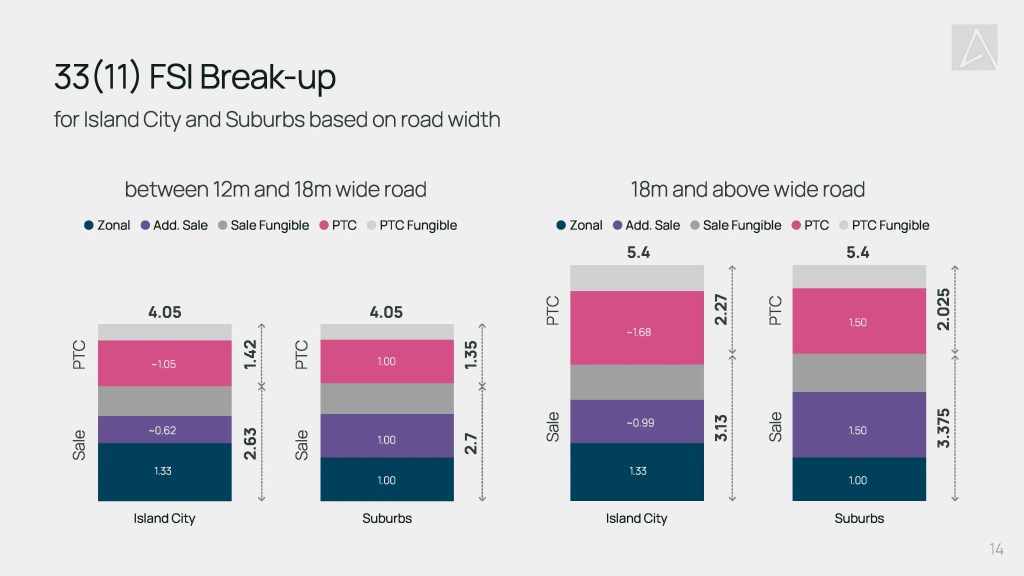
On an 18m-and-above road, the ceiling rises to 5.4 FSI, with the Sale/PTC split adjusting accordingly (Island City: Sale ≈ 3.13, PTC ≈ 2.27; Suburbs: Sale ≈ 3.375, PTC ≈ 2.025).
The key point: the PTC component isn’t a bonus you can ignore — it’s a mandatory part of the FSI basket, and how you choose to build it out (in-situ vs. clubbed elsewhere) materially changes your project economics.
In-situ vs. Clubbing — the real financial trade-off
Developers commonly ask whether they should build the PTC units on the main plot (“in-situ”) or club them onto another plot with a lower Annual Schedule of Rates (ASR).

Clubbing looks attractive on paper — it frees up more sale area on the primary, higher-value plot — but it comes with real costs:
- Higher sale component → increased revenue (extra area × sale price)
- Unearned income payment → an increased cost (PTC area × 40% × ASR differential)
- Cost of acquiring PTC units on the other plot → PTC area × purchase price
In our illustrative comparison, shifting the PTC component to another plot pushed revenue up from ₹4,000 Cr to ₹6,000 Cr (+50%), but total costs also rose from ₹2,300 Cr to ₹3,400 Cr (+47%) once the unearned income payment and PTC purchase cost were factored in — netting a 53% improvement in margin, but only after those costs were correctly accounted for. Skipping this step is one of the most common feasibility mistakes we see.
The relaxations that make 33(11) attractive
Beyond FSI, 33(11) of DCPR 2034 carries a set of regulatory concessions that materially ease design and cost:
- Road setback is included for FSI calculation (rather than being a pure deduction)
- Loss of Sunlight/Ventilation (LOS) requirement relaxed to 8% of the balance plot
- Parking requirement relaxed to 50%
- OSD (Open Space Deficiency) / staircase premiums capped at 10%
- No staircase premium applicable on the rehab component
These relaxations, taken together, are often what makes an otherwise tight 33(11) project pencil out.
A common mistake: road setback and FSI
One land parameter that consistently skews feasibility workings is the road setback. Under 33(11):
- Zonal FSI is computed on (Gross Plot Area − Road Setback)
- Max FSI, however, is computed on the Gross Plot Area, without deducting the setback
- The balance area available for sharing between rehab and sale is adjusted accordingly
For example, on a 1,000 sq.m. plot with a 100 sq.m. road setback: Zonal FSI area works out to 900 sq.m., while Max FSI area (at 4x) is 4,000 sq.m., leaving a balance area of 3,100 sq.m. Getting this sequencing wrong is a frequent — and costly — error in initial feasibility studies.
33(11) vs. 33(20B): picking the right route
We also compared 33(11) (SRA route) against 33(20B) (MCGM’s Affordable Housing/R&R route), since developers often have to choose between the two:
| Parameter | 33(11) | 33(20B) |
| Planning/ Governing Authority | SRA | MCGM |
| Unit Allotment | PTC → Permanent Transit Camps | PAP → Project Affected Persons |
| Ancillary Areas (anganwadi etc.) | Applicable | Not Applicable |
| Min LOS requirement | 8% of balance plot | 10% of balance plot |
| Staircase Premium on PTC/PAP | Not Applicable | 10% of nominal |
| Development Cess/ Infra Charges | 2% of RR | Not Applicable |
Neither route is universally “better” — the right choice depends on plot context, timelines, and which authority’s process fits your project better.
Key learnings
- If the PTC component is built in-situ, the maximum usable FSI is effectively below 4.05 or below 5.4 (not the full headline number) — plan your massing accordingly.
- Road setback skews FSI area calculations — zonal and max FSI are computed differently, and getting the sequence wrong understates or overstates buildable area.
- Clubbing PTC units increases revenue, but also increases costs — unearned income and PTC purchase cost must be built into any feasibility model before comparing it against building in-situ.
We also referenced a few live 33(11) projects worth studying for anyone who wants to see the scheme applied in practice: Lodha Signet (Vikhroli W), Bellanza Phase 1 (Mulund W), Girnar Apartment CHS (Borivali W), and Queen of Spaces (Bandra W).
Stay in the loop
Join the Archonet DCPR Learning Circle on WhatsApp for updates on future sessions and regulatory changes.
For more on LandWise, reach out to us on info@archonet.co