

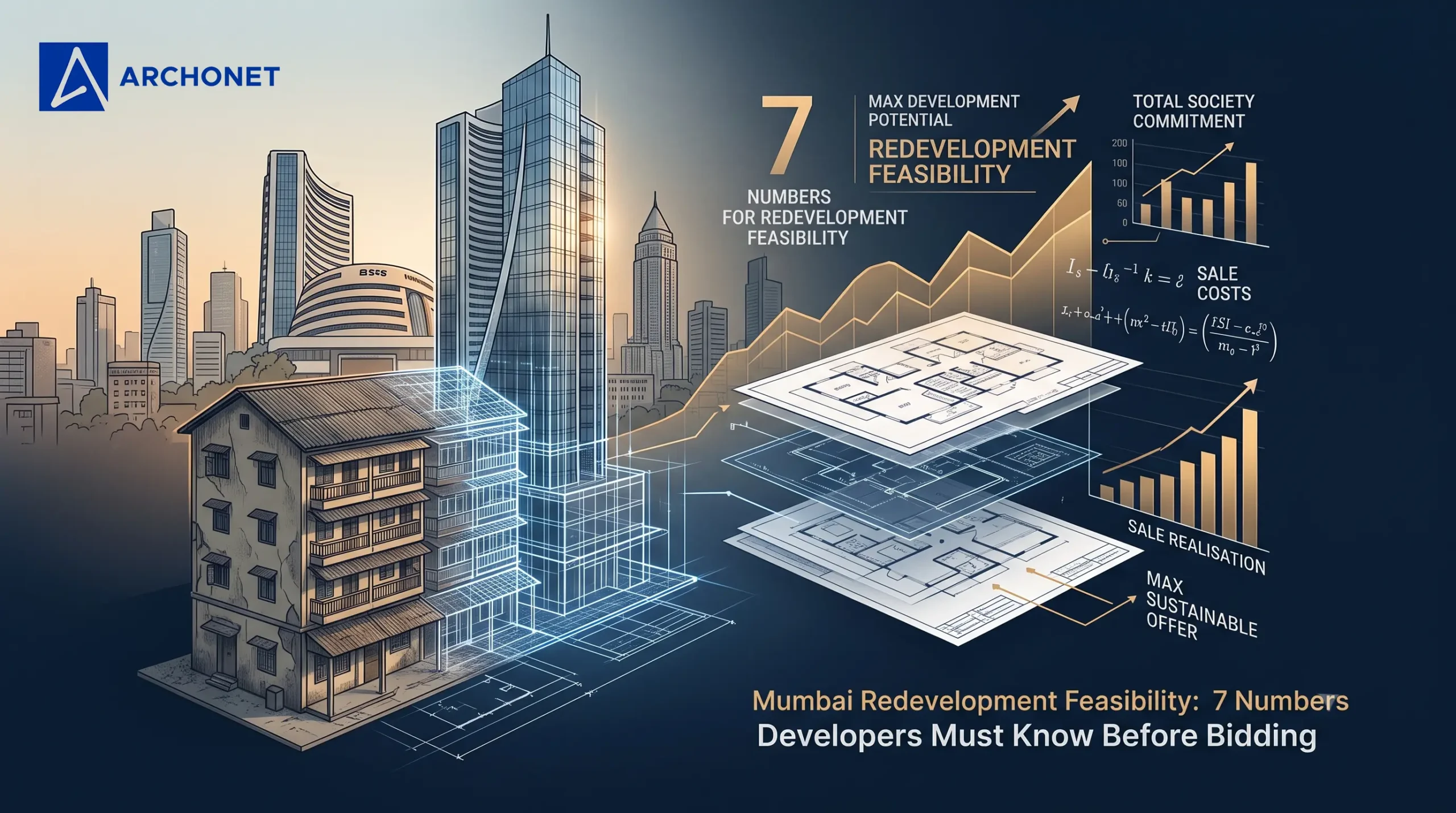
A housing society invites bids for redevelopment.
One developer offers 30% additional area. Another offers 40%. A third offers 50%, a higher corpus and better rent.
Who has made the best offer?
From the society’s perspective, the answer may seem obvious. From the developer’s perspective, it is not.
The real question is: How much can this project actually afford to offer?
That question is becoming increasingly important in Mumbai. According to a recent JLL–NAREDCO report, more than 1,000 redevelopment projects have been launched since 2020, accounting for approximately 13% of Mumbai’s residential supply and 15% of housing sales. Borivali, Malad, Andheri, Vikhroli and Goregaon alone account for around 36% of redevelopment launches.
As more developers compete for redevelopment opportunities, societies naturally expect better offers. But winning a project with an aggressive offer and executing it profitably are two very different things.
Before submitting a bid, a developer needs clarity on seven numbers.
Table of Contents
Opportunity to decision workflow
1. What is the Maximum Development Potential in Mumbai redevelopment case?
Every redevelopment feasibility begins here. But calculating development potential isn’t simply: Plot Area × FSI
Depending on the property, multiple provisions of DCPR 2034 may need to be evaluated. The development potential could be influenced by:
- Applicable redevelopment scheme
- Base FSI
- Premium FSI
- TDR
- Fungible compensatory area
- Road width
- Plot area and configuration
- Reservations and setbacks
- Height restrictions
- Scheme combinations and additional provisions
A cooperative housing society, for instance, may need to be evaluated under Regulation 33(7B), while certain larger redevelopment opportunities may qualify under Regulation 33(9). Other provisions or combinations may create a different development outcome.
The important question is therefore not just: “What FSI is permissible?”
It is: “Which development route gives us the most viable development potential?”
Two schemes producing similar FSI can still have very different obligations and costs. As we discussed in our earlier DCPR 2034 guide, feasibility requires comparing development pathways—not simply identifying the highest FSI.
2. How Much Area Goes Back to Existing Members?
Maximum development potential is not the same as sale potential.
Suppose a redevelopment project has:
Total development potential: 3,00,000 sq ft
That number can look attractive until the rehabilitation obligation is considered.
If existing members occupy 1,00,000 sq ft and the developer offers them 40% additional area, the member entitlement alone becomes:
1,00,000 + 40,000 = 1,40,000 sq ft
And that is before accounting for other non-sale components and project-specific obligations.
This gives developers a much more relevant equation:
Development Potential – Rehab Commitment – Other Non-Sale Components = Potential Available for Sale
This is why existing member area is one of the first numbers a redevelopment team should establish accurately.
3. What Does Every Additional 5% Offered to the Society Cost?
This is where redevelopment negotiations become interesting.
Consider an illustrative society with 1,00,000 sq ft of existing member area.
| Additional area offered | Additional member area |
|---|---|
| 30% | 30,000 sq ft |
| 35% | 35,000 sq ft |
| 40% | 40,000 sq ft |
| 45% | 45,000 sq ft |
| 50% | 50,000 sq ft |
Moving from a 30% to 50% offer means committing another 20,000 sq ft to members.
That additional area has an economic consequence.
It has to be constructed. It affects the project’s area balance. Depending on the development structure, it may reduce the area available for monetisation or require additional development rights and associated expenditure.
Therefore, during negotiations, the BD team shouldn’t only ask: “Can we increase our offer from 40% to 45%?”
They should be able to ask: “If we increase the offer by 5%, what happens to our project cost, sale potential, margin and IRR?”
That changes a negotiation from intuition-led bidding to data-backed bidding.

4. What is the Total Society Commitment?
Additional carpet area gets most of the attention during redevelopment negotiations, but it isn’t the developer’s only commitment.
The actual society package may include following in addition to Additional Area:
- Corpus
- Transit Rent
- Rent Escalation
- Shifting Charges
- Brokerage
- Amenities
- Society Expenses
- Other Tender Commitments
Rent is particularly important because it is linked to time.
A ₹3 crore annual rental obligation planned for three years becomes ₹9 crore.
If approvals, demolition or construction push the timeline to four years, the same obligation becomes ₹12 crore—even before considering escalation.
This is why redevelopment financial feasibility cannot be separated from project scheduling and cashflow. Delays affect rent, financing costs, construction escalation and ultimately returns.
The society offer therefore needs to be evaluated as a complete financial obligation, not as an additional-area percentage alone.
5. What Does It Cost to Unlock the FSI?
Consider two redevelopment strategies that both produce approximately the same development potential.
Are they financially equivalent? Not necessarily.
One route may involve a different mix of:
- Premium FSI
- TDR
- Fungible FSI
- Development Rights
- Authority share
- PAP/PTC obligations
- Premiums and statutory payments
- Scheme-specific concessions or costs
This creates an important distinction between: Maximum FSI and Optimal FSI.
The highest permissible FSI is valuable only when the incremental area creates more value than it costs to unlock and construct.
That is why:
Highest FSI does not necessarily mean highest profit.
For a BD or land acquisition team, knowing that a plot can achieve a particular FSI is only half the answer.
They also need to know what it costs to get there.
6. What Sale Realisation and Sales Velocity Does the Project Need?
Once development potential and project obligations are established, another assumption begins driving the feasibility:
How much can the free-sale inventory actually realise?
A model may assume ₹35,000 per sq ft because competing projects are quoting similar rates.
But asking price, agreement value and effective realisation are not necessarily the same.
Developers need to evaluate:
- Comparable project pricing
- Effective realisation
- Unit configuration
- Inventory absorption
- Sales velocity
- Channel commissions and incentives
- Price escalation assumptions
- Timing of sales collections
This matters because a project can remain profitable on paper while becoming capital-intensive in reality.
If inventory expected to sell in 18 months takes 30 months, the headline selling price may remain unchanged while financing cost and cashflow requirements change materially.
Our earlier analysis of Mumbai’s realisation gap explored precisely this problem: the rate carried in a feasibility model is not automatically the money or timing the project ultimately realises.
7. What is the Maximum Sustainable Offer? How does it affect Mumbai redevelopment feasibility?
This is ultimately the number the redevelopment team needs before entering a competitive negotiation.
Instead of starting with: “What should we offer the society?”
work backwards from the economics of the project.
The logic is simple:
Expected Project Revenue
– Construction Cost
– FSI / Approval / Statutory Costs
– Finance Cost
– Marketing & Overheads
– Rent, Corpus & Other Society Obligations
– Target Developer Return
= Economic Headroom Available for the Deal

The developer can then evaluate how that headroom should be distributed across additional member area, corpus, rent and other commercial commitments.
This creates a maximum sustainable offer.
Beyond this point, the developer may still win the society—but could start losing the economics of the project.
The Bid Should Be an Output of Feasibility
Traditionally, redevelopment feasibility can become fragmented across multiple people.
The BD team obtains the opportunity.
The architect calculates development potential.
The liaison team evaluates DCPR provisions.
The finance team builds a financial model.
The sales team provides expected realisation.
Management finally decides how aggressively to bid.
The challenge is not that any one of these steps is unnecessary.
The challenge is that the society undergoing redevelopment in Mumbai may expect the offer before the entire cycle is complete.
And during negotiations, assumptions keep changing.
What if we offer another 5% area? What if rent increases by ₹10 per sq ft? What if another DCPR scheme gives higher development potential? What if sales happen six months slower? What if the selling price is 5% lower?
Every change affects the offer the project can sustainably support.
From Opportunity to Decision
This is the workflow we believe redevelopment feasibility in Mumbai should follow:
Opportunity
↓
Identify Applicable DCPR Schemes
↓
Compare Development Potential & FSI Cost
↓
Calculate Rehab + Society Commitments
↓
Estimate Sale Potential & Realisation
↓
Model Cashflow & Returns
↓
Stress-Test the Society Offer
↓
Go / No-Go / Revised Offer
At Archonet, LandWise helps teams evaluate the regulatory side of this decision—applicable schemes, FSI potential, scheme comparisons, approval costs, height constraints and other development considerations.
FinWise takes the development potential forward into financial feasibility—project costs, revenues, cashflows, financing requirements, IRR, NPV and scenario analysis.
The objective is not to replace the judgement of a developer’s BD, architecture or finance team.
It is to give all of them a common feasibility baseline before a commitment is made.
Winning the Society Is Only Half the Deal
Mumbai’s redevelopment opportunity is getting larger, more organised and more competitive.
That makes speed important.
But it makes pricing the opportunity correctly even more important.
The strongest redevelopment bid is not necessarily the one offering the highest additional area, highest corpus or highest rent.
It is the most competitive offer that the underlying project can sustainably support while preserving the developer’s required return.
Because in redevelopment, winning the society is only half the deal.
Winning it at the right feasibility is what matters.