

For a developer evaluating a land opportunity in Mumbai, the first question is often:
“How much FSI can I get?”
But FSI is only the starting point.
The more important questions are: Which scheme applies? Can it be combined with another scheme? What development potential does it create? What does it cost to unlock? And does it actually improve project viability?
DCPR 2034 provides multiple development pathways across residential, commercial, redevelopment and specialised projects. Understanding the schemes is therefore less about memorising regulations and more about knowing which ones to evaluate for a particular opportunity.
At Archonet, we recently hosted “DCPR 2034 Unlocked: Every Development Scheme That Matters in Mumbai”, with 70+ active attendees. The discussion focused on the schemes developers should know, how to shortlist them and how to compare their development potential and cost.
Watch the full webinar recording here. This article builds on that discussion.
From Individual Regulations of DCPR 2034 to a Development Framework
We have previously covered the individual provisions under Section 33 in detail in our article here
That article is a deeper regulation-by-regulation reference.
This article takes a different approach. We have grouped the key DCPR 2034 development schemes into four practical categories based on on the framework used in our webinar:
- Applicable to Both Greenfield & Redevelopment
- Redevelopment Only
- Greenfield Only
- Add-on Schemes
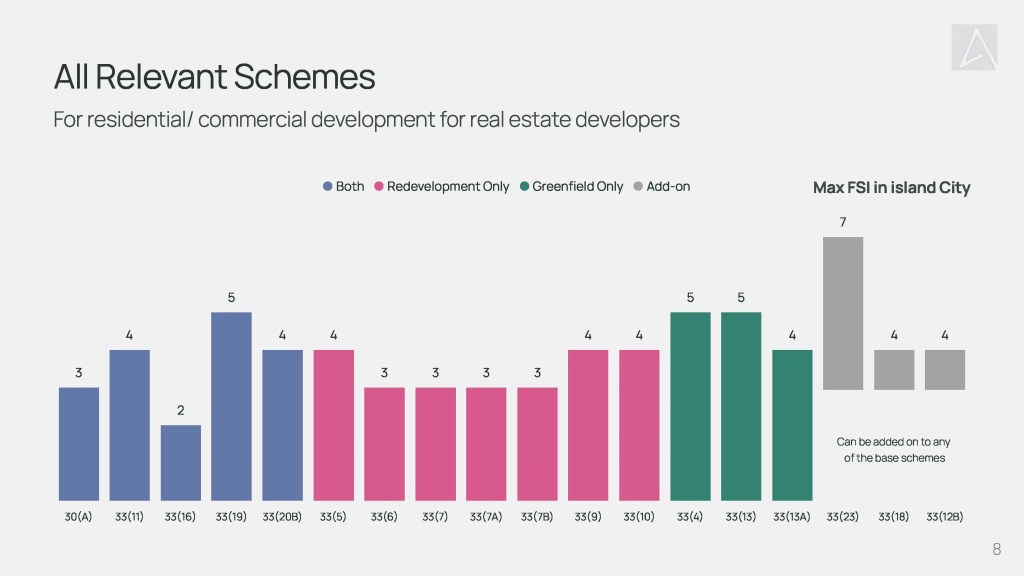
This gives a developer a starting point: What schemes should I be checking for this opportunity?
1. Schemes Applicable to Both Greenfield & Redevelopment
The webinar identifies 30(A), 33(11), 33(16), 33(19) and 33(20B) in this category.
30(A) — Base DCPR
30(A) is the base development framework under Table 12 and is often the starting point for feasibility.
It provides a relatively straightforward benchmark, but redevelopment projects may have better alternatives through incentive-based schemes. For industrial plots, the presentation highlights a base FSI of 1.0, with conversion to residential/commercial use potentially allowing substantially higher development potential.
33(11) — PTC Scheme
33(11) requires a minimum 12m road width and provides a PTC-based development pathway. Its key advantages include the ability to shift the PTC component to an alternate plot and concessions in LOS, parking, OSD and staircase premiums.
But the additional potential comes with a cost: a significant portion of the area above zonal FSI is handed over as PTC, and shifting PTC can trigger unearned income.

33(16) — Gaothan, Koliwada & Adiwasi Areas
This provision covers development/redevelopment in specified Gaothan, Koliwada and Adiwasi areas. The presentation highlights that consumed FSI in existing buildings can be permitted irrespective of the FSI cap. However, the overall FSI cap can make it less attractive than some higher-potential alternatives.
33(19) — Commercial Development
33(19) provides additional FSI over Table 12 at 50% of RR, subject to the scheme’s conditions. It is particularly relevant for commercial-led projects.
One important limitation: the residential component is restricted to 30% of Table 12 FSI, and additional premium FSI cannot be used for residential purposes.
This makes the comparison with 33(13) particularly relevant: 33(13) is specialised for IT/Data Centres, while 33(19) is a commercial development pathway. Neither is universally “better”; the intended use and project economics determine the answer.
33(20B) — PAP / AH / R&R
33(20B) is one of the more significant high-FSI pathways to evaluate, with PAP/AH/R&R forming the core of the scheme.
It provides relaxations in areas such as LOS, parking, OSD and staircase premiums, while the PAP component can be shifted to an alternate plot subject to applicable conditions.
But the headline FSI doesn’t tell the whole story.
Whether PAP is constructed in-situ or clubbed elsewhere changes the FSI composition and financial outcome. Clubbing can increase sale potential but also introduce PAP purchase cost, unearned income and other associated costs.
We have explored these mechanics separately here.
2. Redevelopment-Only Schemes of DCPR 2034
The second category covers 33(5), 33(6), 33(7), 33(7A), 33(7B), 33(9) and 33(10) of DCPR 2034 schemes for redevelopment.
The existing building and ownership condition often become the first filter.
33(5) — MHADA
Applicable to MHADA layouts, 33(5) provides additional entitlement for existing units and incentive FSI linked to the land-rate/reconstruction-cost relationship. MHADA surplus, where applicable, can be utilised for sale by paying the relevant premiums.
33(6) — Destroyed / Collapsed / Demolished Buildings
This scheme applies to eligible buildings destroyed by fire, collapsed or demolished. A notable advantage is the lower staircase and OSD premium, at 25% of the nominal rate, although agreement from at least 70% of existing occupants is required.
33(7), 33(7A) & 33(7B)
These provisions address different redevelopment situations:
- 33(7) — Cessed buildings
- 33(7A) — Non-cessed tenanted buildings
- 33(7B) — Non-cessed CHS

All three have different eligibility, entitlement and incentive structures. Importantly, the presentation highlights their potential combination with 33(20B) to increase development potential.
For a CHS, for example, 33(7B) provides incentive FSI and free fungible area on existing BUA, but its development potential can be more limited than some alternative pathways.
33(9) — Cluster Redevelopment
33(9) requires a minimum plot area of 4,000 sq.m. in the City and 6,000 sq.m. in the Suburbs, along with an 18m road.
It can provide substantial incentive FSI, but the higher potential also comes with larger rehabilitation requirements and, in certain cases, MHADA sharing.
33(10) — Slum Rehabilitation
33(10) applies to notified slums under the SRA framework. Incentive FSI is linked to the rehabilitation component, but the scheme also involves substantial approval and financing considerations, including transit accommodation.
3. Greenfield-Only Schemes
The presentation identifies 33(4), 33(13), 33(13A) and 33(23) as greenfield-only opportunities from the schemes in DCPR 2034.
33(4) — Residential Hotels
Applicable to independent plots with a minimum 12m road width, 33(4) offers additional FSI at a concessional premium of 30% of RR. It is designed for hospitality projects and includes tourism support activities, but also has specific conditions such as reservation of rooms for government bodies and no condonation in parking requirements.
33(13) — IT Establishments / Data Centres
33(13) applies to registered plots with a minimum 12m road width. It provides additional development potential and allows up to 40% BUA for support services, but comes with stringent use conditions and penalties for misuse.

33(13A) — Smart FinTech Centres
This is a more specialised provision, applicable to plots approved by the Directorate of IT and requiring an 18m road. Additional FSI is available at a concessional 40% of RR, with a minimum 85% BUA requirement for core FinTech activity.
4. Add-on Schemes in DCPR 2034
The fourth category is particularly important because these provisions can be added to qualifying base schemes rather than evaluated only as standalone alternatives.
33(12B) — Reaccommodation of Tolerated / Protected Structures
33(12B) can be added to schemes below 4.0 FSI potential and provides free-of-cost incentive FSI up to 50% of the rehabilitation area, subject to applicable conditions. It can be particularly relevant for road-side structures on narrower roads.

33(18) — Public Parking Lots
33(18) requires a minimum 1,000 sq.m. plot and 18m road width. It can provide additional FSI when combined with 33(7), along with paid incentive FSI linked to the PPL area.
This is why add-ons should form part of the initial scheme check, rather than being considered after the feasibility is already prepared.
33(23) — Transit-Oriented Development
33(23) is location-driven, applying to eligible plots within 500m of Metro Line 3 stations, with a minimum 9m road width. The presentation highlights potential up to 7.0 FSI depending on plot area and road width.
The Right Scheme Is Not Always the One With the Highest FSI
The webinar’s framework was simple:
Check Applicability → Compare Maximum Potential → Optimise Approval Cost
Applicability depends on location, plot area, road width and ownership. Maximum potential is then influenced by scheme-specific FSI limits, height and ground coverage. Finally, scheme-specific concessions and premiums determine the cost of unlocking that potential.
This is particularly important when schemes are combined.
For example, 33(20B) can be combined with 30(A), 33(6), 33(7), 33(7A) and 33(7B) under the cited framework. But combinations can also bring pro-rata relaxations and premium applicability.
So the question isn’t simply: “Which scheme gives me the highest FSI?”
It is: “Which scheme gives me the best development potential after accounting for obligations and cost?”
FSI Is Only One Part of the Feasibility
Road setback, CRZ II, existing structures, reservations, notified slums, irregular plot shape, height constraints and existing tenement sizes can all affect the final outcome.
This is why two plots with similar areas can produce very different feasibility results.
And for schemes involving PAP/PTC, the cost structure becomes even more important. Under 33(20B), for example, clubbing can increase sale potential but also introduce PAP purchase cost and unearned income.
Same FSI does not necessarily mean same viability.
From Regulations to a Development Decision
For a Business Development team evaluating a new opportunity, the ideal process is:
Land Opportunity
↓
Identify Applicable Schemes
↓
Check Combinations & Add-ons
↓
Compare FSI & BUA
↓
Calculate Approval Costs & Obligations
↓
Evaluate Financial Feasibility
↓
Go / No-Go
This is where LandWise fits into the process.
LandWise helps developers identify applicable schemes, generate FSI statements, compare development pathways and calculate approval costs as part of the initial feasibility exercise.
The objective is not just to answer “What can I build?”
It is to help answer:
“Which development pathway makes the most sense for this opportunity?”
DCPR 2034 Is a Decision Framework
There isn’t one universally “best” scheme.
A CHS may point towards 33(7B). A cessed building towards 33(7). A MHADA layout towards 33(5). A cluster opportunity towards 33(9). A notified slum towards 33(10). A specialised IT or FinTech opportunity towards 33(13) or 33(13A).
And in several cases, the real opportunity may lie in combining schemes or adding another provision.
Understanding DCPR 2034 therefore isn’t about knowing one FSI number.
It is about knowing what applies, what can be combined, what it costs, and what remains viable after all of it is considered.
DCPR 2034 tells you what you can build.
Feasibility tells you what is worth building.