

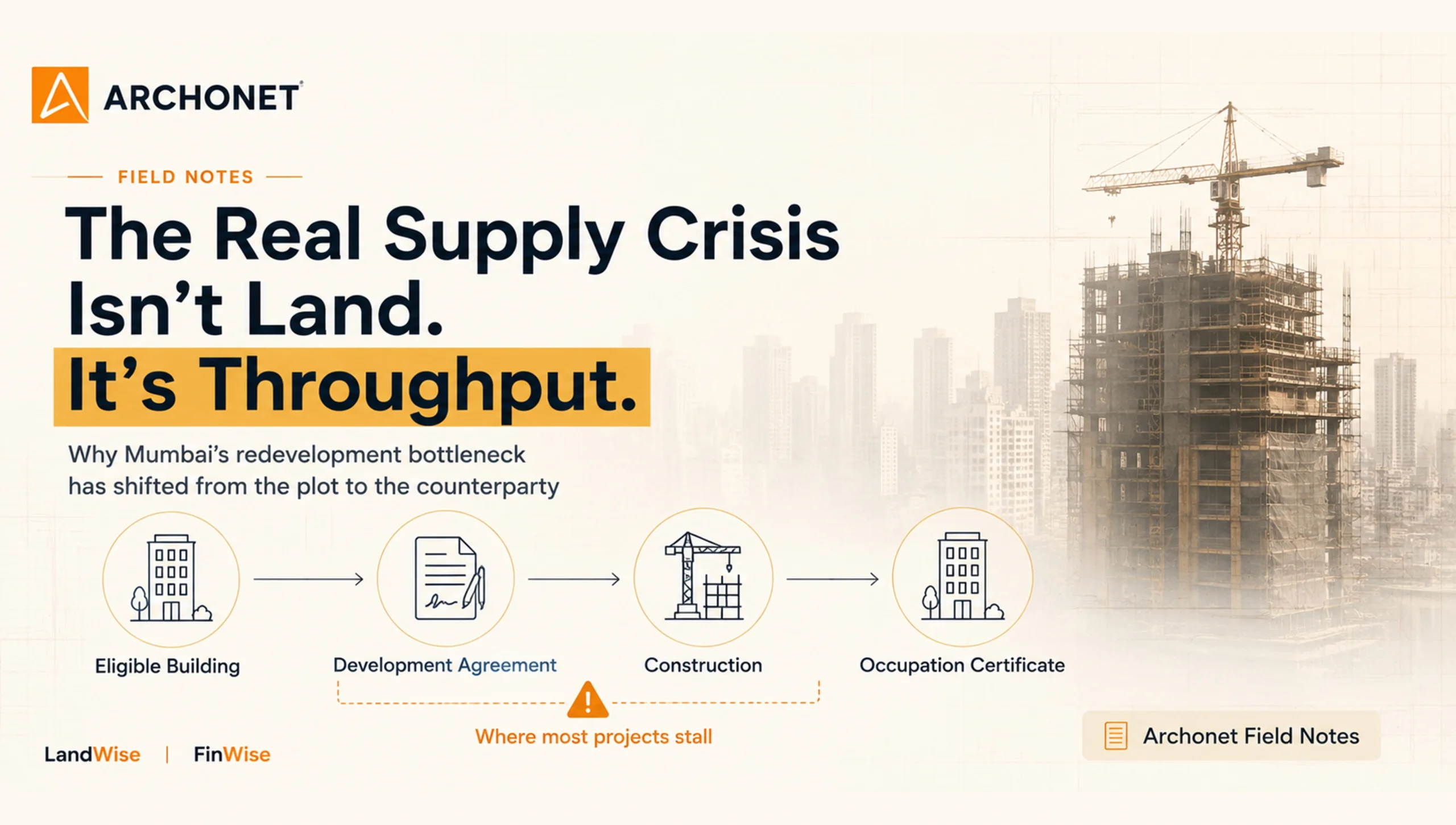
Why Mumbai’s bottleneck moved from the plot to the counterparty
Mumbai has more than 1.6 lakh buildings already eligible to redevelop. Fewer than one in a hundred eligible societies ever reach a signed development agreement — and a significant share of those that do, stall. The scarce resource was never land. It was the ability to get a deal from signature to occupation.
You’ve walked past the site so many times you’ve stopped noticing the tarpaulin. Eighteen months ago the boundary wall came down and the scaffolding went up, and the redevelopment committee shook your hand like the hard part was over. It wasn’t. The building behind that wall was supposed to have its occupation certificate by now. Instead the site engineer stopped returning your calls three weeks ago, and the transit rent cheque sitting on your desk is the nineteenth one, not the second.
None of this is your first redevelopment, so you’ve already built the mental model the hard way: FSI is finite, Mumbai’s land hasn’t grown in decades, and a serious developer treats scarce buildable area as the thing that decides whether a deal is worth chasing. That instinct isn’t wrong. It’s just answering a question the market largely stopped asking around the time DCPR 2034 opened up more redevelopment routes than most owners ever bother to compare.
Mumbai Has 1.6 Lakh Buildings Eligible to Redevelop. Here’s Why Most Never Move.
Here’s the number that should unsettle that instinct. According to the BMC’s structural audit data, more than 1.6 lakh buildings across Mumbai have already crossed the 30-year mark — with the highest concentration in the Western Suburbs (46%), followed by the Island City (28%) and the Eastern Suburbs (26%). Every one of them is technically eligible to redevelop right now.
Against that standing stock, Knight Frank’s June 2026 report counts 1,094 societies currently under active redevelopment — collectively unlocking nearly 432 acres of land across the city. The same pipeline is projected to deliver approximately 59,000 new homes by 2031, at an estimated market value of ₹1.5 lakh crore.
Both numbers are real. Neither is the point. The point is that eligibility was never the scarce resource here, and every developer who has ever lost a year to a stalled site already knows what is.
The Standing Stock 1.6 lakh+ buildings, already eligible Every one of them past the 30-year mark. A queue nobody is short of.
Ask why so much eligible stock stays exactly where it is, and the answer isn’t zoning, and it isn’t FSI.
The causes that industry practitioners consistently identify — and that MahaRERA’s own enforcement caseload makes visible — are developer liquidity stress and legal disputes over entitlements, carpet area, and tenant eligibility. MahaRERA is currently working through a backlog of over 7,500 pending complaints, with recovery warrants worth over ₹700 crore outstanding against developers. The pattern in contested cases is consistent: projects enter dispute not because the building couldn’t be redeveloped, but because the counterparty ran out of capital or the agreement didn’t survive contact with a disagreement.
Not land. Not design. Not the approval queue most people assume.

The MMR Redevelopment Conversion Problem: 25,000 Eligible Societies. 1,094 Signed Agreements.
Zoom out to the wider metropolitan region and the same pattern holds, this time in units that compare cleanly. Knight Frank’s data from the Mumbai Redevelopment Summit counts approximately 25,000 housing societies across MMR that are technically eligible to redevelop under DCPR 2034. Between 2019 and early 2026, only around 1,094 of them have reached an active signed development agreement.
Same denominator, same unit, six years of runway. DCPR 2034 itself expects a project that does get signed to close out in under two years from the first building’s completion certificate, three years only in exceptional cases. Industry practitioners and lenders tracking the MMR pipeline consistently flag that a meaningful share of signed agreements are running materially past those windows — with cash flow unpredictability in the first three to four years cited by lenders as the primary reason why hard collateral is increasingly demanded upfront.
The conversion rate from eligible to active is below 5% across MMR. Eligibility is abundant. Completion is not.
What a Two-Year Redevelopment Delay Actually Costs: A Field Case
Field Case — An Illustrative Pattern, Not an Actual Project
Picture one of those stalled agreements. Sixty tenements, a two-year build, transit rent budgeted at ₹35,000 a month per family. The developer signs, breaks ground inside DCPR’s own window, and everything holds until somewhere past month eighteen.
Then one of two things happens. Either the capital allocated to this site was always thinner than the pitch suggested, and a second project elsewhere in the portfolio starts pulling cash away from this one. Or a dispute surfaces — over who’s entitled to a unit, over a carpet-area calculation, over a promise made in a society meeting that never made it into the agreement — and the file moves from the construction site to a MahaRERA tribunal.
Either way the project lands in year four instead of year two. Here is what those twenty-four extra months cost, before anyone argues about whose fault it was.
| Cost head | Amount |
| Transit rent, 60 families × 24 extra months | ₹5.04 crore |
| Interest carry on deployed capital, 24 months at ~14% p.a. | ₹7.00 crore |
| Construction cost escalation at ~6% p.a. on remaining works | ₹3.20 crore |
| Cost of a two-year delay, before a single rupee of lost sales | ₹15.2 crore |
A delay of this length can move a project from a healthy 22% IRR into single digits without one number in the original feasibility being wrong. The scheme was right. The FSI was right. The counterparty ran out of road.
Left: of the ~1,094 signed agreements across MMR, a significant share are running past DCPR’s expected completion windows. Right: the cost of a two-year delay on a 60-tenement scheme, at stated assumptions. Illustrative composite, not an observed project.
Will this specific developer still be stanThe Counterparty Question Most Redevelopment Feasibility Checks Skipding?
The question that most diligence exercises skip is the one that decides whether any of the rest matters:
Will this specific developer still be standing — financially and legally — on the day the occupation certificate is supposed to arrive?

Why Mumbai Redevelopment Projects Stall — And Who’s Actually Responsible
Most of those stalled agreements weren’t signed in bad faith. Planning cashflow three years out across a multi-project portfolio is genuinely hard, and disagreements over carpet area or tenant eligibility usually start as honest disputes, not fraud.
A good developer’s read on a society — whether the managing committee is unified, whether the tenant mix is cooperative, whether the local ward office moves quickly — isn’t something a dashboard replaces. Experience still decides whether a project gets built well. What experience alone can’t always do is see two years into a developer’s own balance sheet, or into a legal dispute that hasn’t been filed yet.
As Rachna Lakhotia of Tata Realty & Infrastructure noted at the Mumbai Redevelopment Summit: cashflows are unpredictable in the first three to four years of a redevelopment, and the absence of hard collateral significantly elevates lender risk. Lenders have responded by moving to milestone-based disbursements and escrow controls — a structural shift from growth-led capital to risk-managed capital that changes what developer financial health actually needs to look like before a society signs.
Where this argument doesn’t hold
There are plots where land genuinely still binds. Inside the island city’s cessed clusters, on CRZ-adjacent parcels, under an airport funnel height cap, or on a site whose road width caps the FSI you can actually load — buildable area is the constraint, and no amount of counterparty diligence unlocks it. The throughput argument describes what governs the MMR pipeline in aggregate. It does not describe every individual site, and a developer sitting on a genuinely constrained parcel should trust the plot over the pattern.
Redevelopment Due Diligence in Mumbai: Beyond FSI and Scheme Selection
Feasibility was never really the question of whether a building could redevelop. It’s whether this specific deal, with this specific counterparty, survives the distance between signing and occupation. That’s a different diligence exercise than checking a scheme number.
LandWise — regulatory feasibility
LandWise Is the deal technically sound? Checks the FSI, the scheme, the buildable and rehab area — before a number ever reaches the society.
FinWise — financial stress testing
FinWise Will the numbers survive the timeline? Tests whether a developer’s cash position and financial plan can absorb a delay, a cost shock, or a slow sales quarter — instead of finding out in month eighteen.
Stress-test your cashflow in FinWise →
Mumbai isn’t short on eligible buildings. It has 1.6 lakh of them sitting on the table right now. What it’s short on is deals that get from signature to occupation without a balance sheet or a legal dispute quietly taking the project down. On most sites, in most of MMR, land stopped being the binding constraint some time ago. Throughput took its place — and throughput is a diligence problem, not a scarcity problem.
If your last redevelopment stalled, it probably wasn’t the site. Run the next one through a diligence process built for that question.
Sources: Knight Frank India, Mumbai Redevelopment Report (June 2026) · Knight Frank India, Mumbai Residential Development Report (September 2025) · Knight Frank India, Mumbai Redevelopment Summit 2025 (as reported in Construction World, January 2026) · BMC Structural Audit data (2017, most recent published) · MahaRERA complaint and recovery warrant data (2025–26, as published) · Construction World, Mumbai Redevelopment Summit coverage (February 2026) · DCPR 2034 redevelopment timeline provisions. The field case is an illustrative composite, not a specific project; its figures are worked illustrations at stated assumptions, not observed outcomes.