

If you’ve ever sat across the table from more than one developer about the same plot, you know the frustration. One offers you 40% of the built-up area. Another offers a flat number in crores. A third throws around the phrase “market rate” like it settles anything. Ask any of them how they got there, and you’ll usually get a shrug, a broker’s word, or a number pulled from a neighbouring project that isn’t really comparable.
Here’s the thing — there is a real method behind these offers, whether the developer says so or not. It’s called Residual Land Value, and once you understand it, you stop being the person in the room who has to just trust the number and start being the person who can ask why it’s that number and not higher.
Table of Contents
What Is Residual Land Value?
Land on its own doesn’t have a price tag the way a flat or a car does. Its value comes entirely from what can be built on it and sold or leased afterward. So instead of guessing at a land price directly, developers work backwards. They ask: if I build the best project this land allows, sell every unit, and pay for construction, approvals, marketing, and financing along the way — what’s left over?
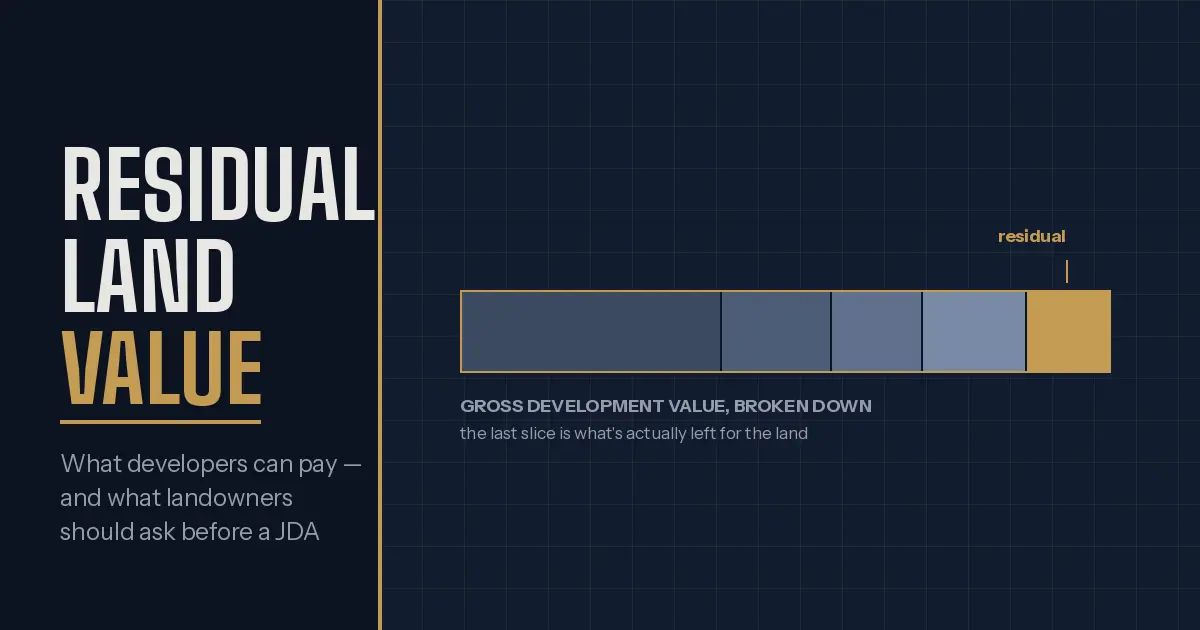
Whatever’s left over is the residual land value. It’s the most a developer can rationally pay for your land (or offer you in area, in a JDA) and still walk away with the profit they need to justify the risk.
How to Calculate Residual Land Value (With a Simple Example)
It’s not complicated, even if it sounds like it:
Residual Land Value = Value of the completed project (GDV) minus everything it costs to build and sell it, minus the developer’s profit.
Break “everything it costs” down and you get construction, architect and consultant fees (usually 10-12% of construction cost), marketing, a contingency buffer (5-10%), and interest on the money borrowed to build it.
Here’s a quick example. Say a developer thinks the finished project will sell for ₹100 crore. Construction, fees, marketing and financing add up to ₹65 crore. They want a 20% profit on that cost — call it ₹13 crore. What’s left is ₹22 crore. That’s the residual. That’s the ceiling on what they can offer you.

Now you can see why two developers looking at your exact plot come back with two very different offers. It’s rarely about the land itself — it’s about what assumptions each one is feeding into that formula. One might be pricing in a higher sale rate. Another might be more conservative on construction cost, or want a fatter margin because they see more risk in the project.
Why Residual Land Value Matters More in a Joint Development Agreement (JDA)
In a Joint Development Agreement, nobody’s handing you cash — you’re getting a share of area, or a share of revenue, or some mix. But underneath, the developer has still run this exact calculation. They’ve worked out the residual first, then converted it into whatever percentage of flats or revenue they’re proposing to give you.
This is exactly where landowners tend to lose out — not because the math is against them, but because they don’t have access to it. The developer walks in with a full financial model. The landowner walks in with a number a broker mentioned last year. So instead of accepting the final offer at face value, ask the questions that actually get behind it:
- What sale rate per square foot is this GDV built on — and does it hold up against what’s actually selling nearby right now?
- What’s the assumed construction cost, and is it realistic given today’s material and labour rates?
- What margin have they built in for themselves, and is that fair for a project of this size and risk?
- Have they counted the full buildable area — including any premium FSI or TDR they plan to buy — or just the base allowance?
You don’t need to build your own spreadsheet to ask these. A developer who’s willing to walk you through the assumptions is telling you something about how they’ll behave for the next four years of construction. One who won’t is telling you something too.
Residual Land Value for Tenanted Properties: The Hidden Cost
Tenanted buildings add a cost line that often gets glossed over — clearing the property of its occupants before construction can even begin. Settlement payments, transit rent while people are rehoused, legal costs if any tenancy is contested, and the sheer time it takes to negotiate everyone out.
All of that comes straight out of the residual. So a tenanted building will, almost always, have a lower residual land value than an identical vacant plot next door — not because the land is worth less, but because getting it construction-ready costs more and takes longer. If you own a tenanted property, this is the one line item worth pushing hardest on. It’s also the easiest place for a developer to lowball you, whether deliberately or just by underestimating how long tenant negotiations actually take.
For Developers: Using Residual Land Value to Build Trust with Landowners
None of this is a secret formula you should be protective of. If anything, the opposite. Landowners are getting sharper about this — they talk to each other, they compare notes, sometimes they even bring in their own advisor before signing anything. An offer explained with real assumptions — this is our sale rate, this is our cost, this is the margin we need — lands very differently than a number with no story behind it. It also keeps you honest with yourself. A residual built on an overly optimistic sale rate or a tenant-settlement line that’s too thin on paper doesn’t disappear — it just shows up later as a project that can’t hit its numbers.
Bottom Line: Know Your Residual Land Value Before You Negotiate
Every land deal, every JDA, every redevelopment offer in this market gets decided by this same logic, whether anyone in the room calls it “residual land value” or not. Knowing the method doesn’t hand you a better number by itself — but it does mean you’re negotiating from the same page as the person across the table, instead of a page behind them.
Try LandWise to find residual value of any plot
How much will I get for my land in a redevelopment or JDA?
There’s no fixed number — it depends on what can legally be built on the plot, current sale rates in the area, and construction and marketing costs. Landowners should ask the developer to walk through their residual land value calculation rather than accepting a flat offer.
How is the area share in a JDA calculated?
The developer calculates residual land value first, then converts it into a percentage of built-up area or revenue instead of cash. A higher residual generally means a better area share.
What’s a fair area share percentage in a JDA?
It varies by location, project size, and FSI or TDR requirements. Landowners should ask for the assumptions behind their own project’s numbers rather than benchmarking against another deal’s percentage.
Is residual land value the same as TDR value?
No. TDR affects how much buildable area a developer gets on a plot, which feeds into the Gross Development Value used in the residual calculation. TDR is a component; residual land value is the outcome.
Does having tenants in my building lower my land’s value?
It usually lowers the residual land value because tenant settlement, transit rent, and the time to secure vacant possession are real costs factored into the developer’s calculation.
Can I negotiate the residual land value a developer has quoted me?
Yes. The sale rate, construction cost, and profit margin behind the number are assumptions, not fixed facts, and can reasonably be discussed and challenged.