

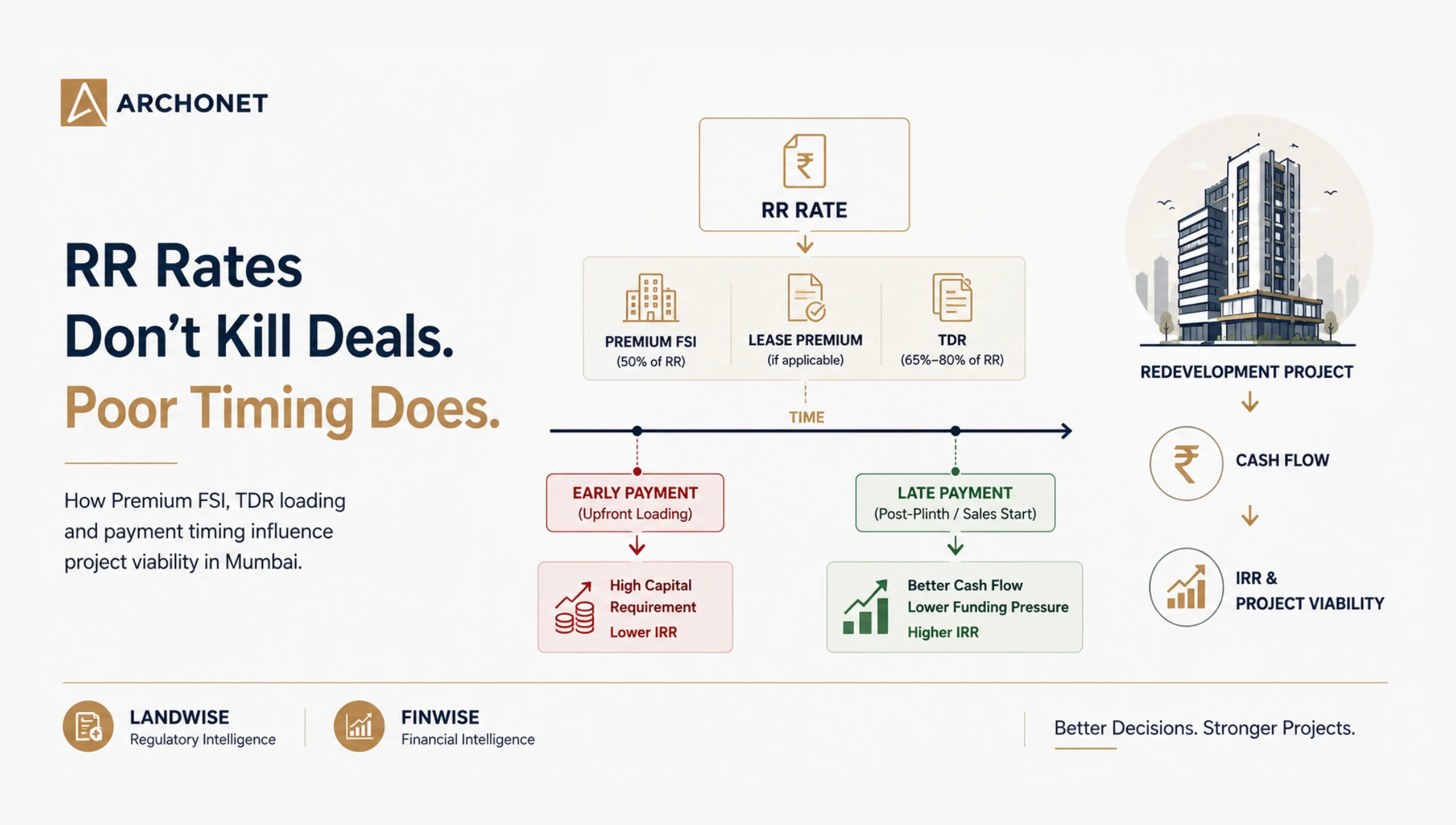
In Mumbai, every feasibility discussion eventually comes down to one number: the Ready Reckoner rate. Developers treat it as the primary cost variable — the number that makes or breaks a deal. It isn’t. RR sets the price of FSI. When you pay that price is what decides your IRR. This blog makes that case with numbers.
What Ready Reckoner rates Actually Control
The Ready Reckoner rate is Maharashtra’s government-published land valuation, revised annually every April 1st. Under DCPR 2034, it directly determines two of the largest cost line items in any Mumbai development:
- Premium FSI costs 50% of RR (per sq.m. of additional area consumed)
- TDR typically costs 65–80% of RR (depending on the generating zone and type)
This makes Premium FSI structurally cheaper than TDR — always, in every micro-market. And it means that every 10% increase in RR adds directly to your FSI acquisition cost, project cost, and therefore your required revenue to stay viable.
So far, most developers follow this logic. What most feasibility models miss is what comes next.
The Variable That Moves IRR More Than RR: When You Pay
RR is a fixed input on a given date. You cannot negotiate it, defer it, or hedge it. What you can control is when the Premium FSI and TDR costs actually hit your project’s cashflow — and that timing decision moves IRR more than the RR rate itself.
In practice, Mumbai projects follow one of two loading sequences:
Sequence A — Late loading (the standard case): Premium FSI and TDR are purchased after plinth completion, by which time RERA registration is obtained, sales have launched, and construction-linked collections have begun flowing. The project is revenue-generating before its largest FSI costs arrive.
Sequence B — Early loading (the society-pressure case): The redevelopment society insists that all FSI — Premium and TDR — be loaded and approved upfront before rehabilitation begins. The developer pays these costs in the first 3–6 months, when cashflow is entirely negative and no sales revenue has yet arrived.

Same RR rate. Same FSI quantum. Same project. Materially different IRR outcomes.
The Worked Comparison: What Timing Actually Costs
The following example uses illustrative assumptions drawn from typical MMR suburban redevelopment parameters. All figures are directional, not deal-specific.
Project: Society redevelopment, 33(7B) scheme, Mumbai suburbs
Plot: 4,000 sq.m.
RR rate: ₹1,10,000 per sq.m.
Saleable FSI: 1.0 (base) + 0.5 (Premium) + 0.9 (TDR) = 2.4 total
Premium FSI outflow: 0.5 × 4,000 × 1,10,000 × 50% = ₹11 crore
TDR outflow: 0.9 × 4,000 × 1,10,000 × 72% = ₹28.5 crore
Total FSI acquisition cost: ₹39.5 crore
Project finance cost: 15% per annum
Saleable area: 95,000 sq.ft. at ₹18,000 psf launch price
Scenario A: Late loading (post-plinth, Month 14) | Scenario B: Early loading (Month 3) | |
| Month FSI costs hit cashflow | Month 14 | Month 3 |
| Sales inflow active at FSI payment? | Yes — collections running | No — zero inflow |
| Interest carry on ₹39.5 Cr (11 months difference) | — | ₹5.43 crore additional |
| Peak negative cashflow | ₹48 crore | ₹87 crore |
| External capital required | Lower | Higher by ₹39 crore |
| Project IRR (base case) | 21.4% | 16.0% |
| IRR differential | — | −5.4 percentage points |
The RR rate is identical in both scenarios. The FSI cost is identical. The only variable is when ₹39.5 crore leaves the project — and that single timing decision costs 5.4 IRR points.
For a developer choosing between two deals at 21% and 16% IRR, timing on the worse project may be the entire explanation for the gap — not market, not product, not RR.
Why This Matters More When RR Is High
The timing effect is not uniform across micro-markets — it amplifies with RR.
In a high-RR zone (Worli, Bandra, Lower Parel), where Premium FSI might cost ₹50–65 crore on a mid-size project, the interest carry on early loading compounds faster and the peak negative cashflow position becomes more severe. The absolute rupee cost of the wrong timing decision is proportionally larger.
In a moderate-RR zone (Chembur, Ghatkopar, Goregaon, Borivali), the FSI outflow is smaller, the interest carry differential is more manageable, and the IRR damage from early loading is contained. This is one structural reason why eastern suburban projects tend to produce more predictable IRR outcomes — not because RR is lower, but because the absolute FSI cost is smaller, making timing errors less punishing.
The practical implication: in any negotiation with a redevelopment society that is pushing for upfront FSI loading, the developer now has a number. The cost of agreeing to their demand is not an abstract risk — it is a calculable IRR reduction. In the example above, it is 5.4 percentage points. That number belongs in the negotiation.
The Installment Scheme: A Partial Mitigant
Maharashtra allows developers to pay Premium FSI in instalments rather than as a lump sum. When structured correctly, this converts a Scenario B (early, lump-sum) situation into something closer to Scenario A in cashflow terms — the outflow is staggered across construction milestones, reducing the peak negative cashflow and the interest carry drag.
Most developers know the instalment scheme exists. Fewer use it proactively as an IRR management tool rather than a cash conservation measure. The distinction matters: if you’re modelling feasibility on the basis of a lump-sum Premium FSI payment and the instalment scheme is available on your project, your feasibility is understating IRR. Always model both payment structures before presenting a go/no-go recommendation to a finance committee.
The 33(20B) Exception: Where RR Comparison Gets More Complex
Under the PAP scheme (33(20B)), the FSI cost structure is materially different from standard Premium + TDR. Developers must account for:
- PAP unit purchase cost (acquiring constructed units at a fixed rate for project-affected persons)
- Unearned income (40% of the difference in RR values between the generating and receiving zones)
This is not TDR, and it does not behave like TDR. The blended cost of PAP + unearned income can be lower or higher than Premium FSI + TDR depending on the specific zone differential — and the comparison changes every April when RR is revised.
If your project involves a 33(20B) combination, you cannot apply standard Premium vs TDR logic. The calculation requires a zone-specific comparison of blended costs at current RR. This is an area where a meaningful number of feasibility errors occur — developers applying suburban TDR benchmarks to a scheme with a fundamentally different cost structure.
A dedicated analysis of the 33(20B) cost comparison — with a worked zone-specific example — will follow as a separate blog in this series.
RR Does Not Decide Viability Alone: A Reference Summary
The table below consolidates how RR interacts with timing risk across Mumbai’s primary development belts. This is not a micro-market ranking — it is a framework for understanding where timing decisions carry the most financial consequence.

What This Means for How You Run Feasibility
Three changes to how most developers currently model RR:
1. Model the FSI loading date explicitly, not as an assumption. Most cashflow models insert Premium FSI and TDR as a month-3 or month-6 cost without questioning whether that timing is negotiable. It often is. The loading sequence should be an explicit variable in the feasibility, with base case and stressed scenarios.
2. Know the instalment scheme availability before you model. If it is available on your project and you are not using it in the model, your IRR is understated and your peak capital requirement is overstated. Both errors matter.
3. In society negotiations, put the IRR cost of early loading on the table. Societies push for upfront FSI loading because they want certainty. Developers agree because they want the deal. Neither party has typically quantified what that agreement costs. The developer who walks into that negotiation with a number — “agreeing to your demand reduces our project IRR by approximately X percentage points, which changes our ability to offer Y corpus / Z rent” — is in a structurally better position than one who absorbs the demand without analysis.
The Archonet Perspective: LandWise + FinWise
RR is a regulatory input. Timing is a financial decision. The two need to be modelled together — which is exactly where static Excel feasibility breaks down.
LandWise gives you the regulatory foundation before any financial modelling begins: applicable FSI under your DCPR scheme, Premium FSI cost at current RR, TDR cost by zone, height restrictions that may cap FSI consumption, and scheme comparison including 33(20B) where relevant.
FinWise converts that regulatory picture into financial outcomes: IRR under late vs early FSI loading, cashflow impact of the instalment scheme, peak capital requirement under each scenario, and sensitivity to RR revision — so you know what an April 1st rate change does to a deal you’re currently underwriting.
The gap between a 21% IRR deal and an 18% IRR deal is often not the plot, the product, or the market. It is a timing decision made without numbers, in a negotiation with a society committee. FinWise gives you the number before you walk into that room.
Explore LandWise → | Model your FSI timing scenarios in FinWise →
Evaluating a redevelopment deal where society is pushing for upfront FSI loading? We can model the IRR differential for your specific project. Reach us at info@archonet.co
All figures in the worked example are illustrative and based on typical MMR suburban redevelopment parameters. They demonstrate analytical method, not a recommendation on any specific project. Run your own deal-level feasibility before committing capital.