

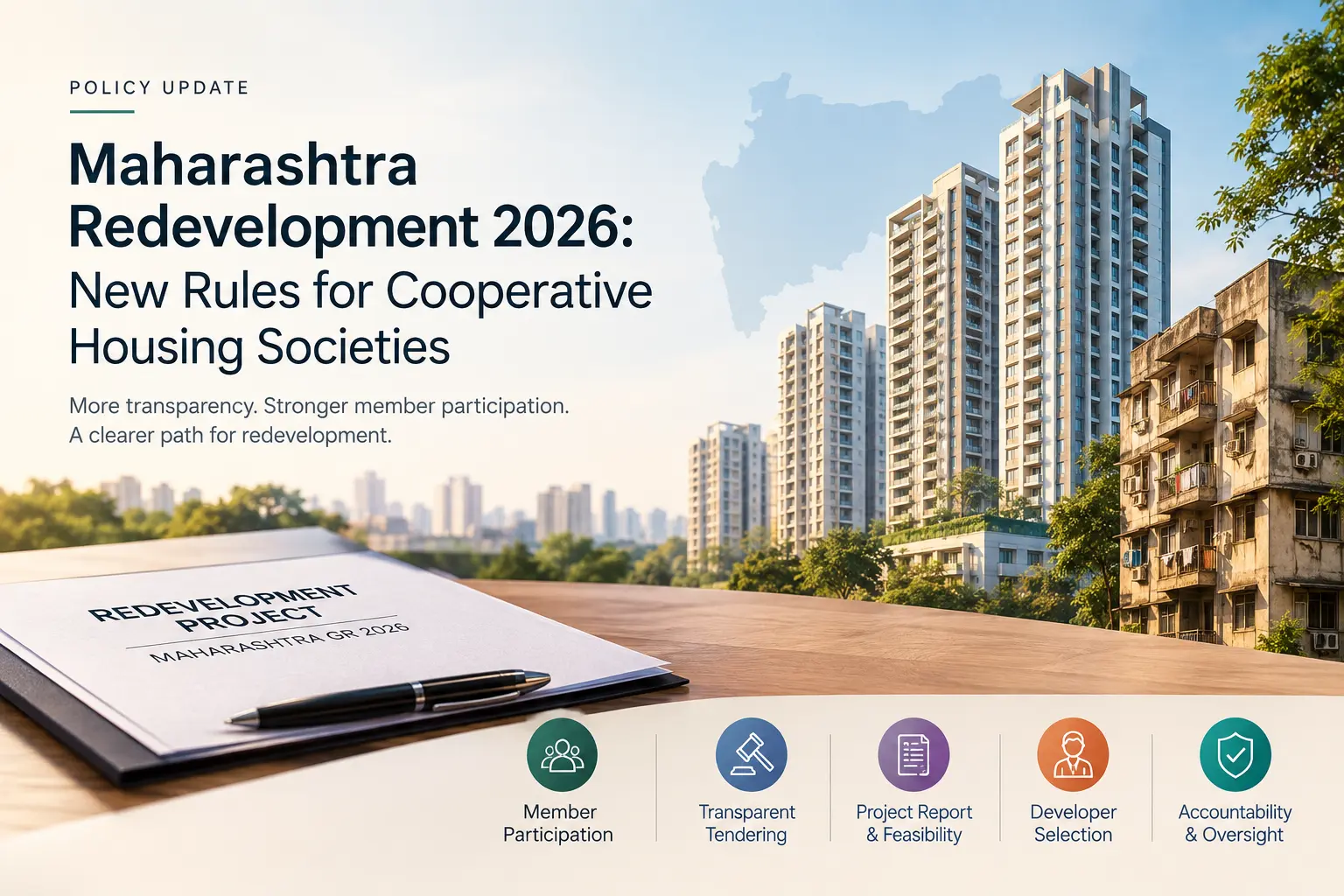
A Turning Point in Redevelopment Governance
Maharashtra’s housing‑society redevelopment framework has entered a new era with the Government Order dated 30 September 2026, issued under Section 79A of the Maharashtra Cooperative Societies Act 1960. This order replaces the 2019 Resolution and all circulars under it, responding to years of complaints about opaque tendering, arbitrary developer appointments, expired committees taking major decisions, and members being left uninformed.
The intent is unmistakable: restore transparency, accountability, and member participation at every stage of redevelopment.
Decision‑Making Power: Legally Constituted Committees Only
Clause 3 of the new GR draws a decisive boundary. Redevelopment decisions can be taken only by a Managing Committee elected under the Cooperative Societies (Committee Election) Rules and validly constituted under law. Administrators or Authorised Officers appointed by the Registrar are explicitly barred from initiating or approving redevelopment. This ends the long‑standing practice of caretaker committees pushing through redevelopment deals without member mandate.
Member‑Driven Process: From Proposal to Special General Body Meeting
If one‑fifth of members submit redevelopment proposals or suggestions, the Secretary must place them before the Managing Committee within eight days. A Special General Body Meeting (SGM) must then be convened within two months, with a 14‑day advance agenda.
Before the meeting, the committee must obtain quotations from at least three architects or PMCs from the government or local‑authority panel. The SGM itself selects one expert to prepare the project report — ensuring that technical evaluation begins with member consensus.
Quorum and Approval: Two‑Thirds Attendance and 51 % Majority
The quorum requirement remains stringent: two‑thirds of total members must attend. If quorum fails twice, the meeting is cancelled and the issue cannot be revived for three months. For any redevelopment resolution to pass, 51 % of the total membership — not just those present — must approve. This distinction prevents small groups from steering large‑scale decisions.
Remote Participation with Physical Safeguards
For the first time, the 2026 Order formally allows video‑conference or remote attendance for members who are abroad, seriously ill, or disabled. Their participation counts toward quorum and majority, but at least 51 % of total members must be physically present. This hybrid model balances inclusivity with authenticity of attendance.
Written Consent After Resolution
Once redevelopment is approved, the Managing Committee must obtain written consent from members who voted in favour before proceeding further. The GR distinguishes between voting approval and written consent, adding a documentary layer of accountability.
Project Report: Comparative, Transparent, and Time‑Bound
The appointed architect or PMC must prepare a comprehensive project report within two months, covering:
- Land ownership and conveyance status
- Applicable regulations (MHADA, SRA, MMRDA, CIDCO, Municipal Councils)
- Available FSI/TDR and scheme‑wise comparisons under DCPR/UDCPR
- Members’ requirements for residential, commercial, open‑space, and parking areas
The report must be discussed in a committee meeting within 30 days, opened for member inspection, and approved before any tendering begins.
Where Archonet helps: This stage aligns perfectly with Archonet’s LandWise engine, which automates scheme‑wise feasibility and FSI comparison under DCPR/UDCPR. LandWise can instantly generate comparative project reports, highlight regulatory constraints, and quantify development potential — enabling societies and PMCs to make data‑driven decisions before tendering begins.
Tendering: Public, Competitive, and Member‑Approved
The tender draft now requires SGM approval before advertisement. Notices must appear in high‑circulation Marathi and English newspapers, inviting reputed developers to bid. At least three tenders are mandatory; if fewer are received, extensions of 15 days and 7 days are allowed before proceeding.
The PMC must prepare a comparative statement evaluating quality, reputation, experience, and financial capability — shifting tendering from committee discretion to transparent competition.
Developer Selection: Registrar Oversight and Member Control
The mandatory presence of an Authorised Officer appointed by the Registrar at the developer‑selection SGM is one of the most transformative changes. The society must first submit minutes, member list, project report, tenders, and comparative statement. The Registrar must appoint the officer within 14 days.
The meeting itself requires:
- Two‑thirds quorum and 51 % physical attendance
- No proxy representation — only verified members with ID and share certificates
- Video recording retained by both the Secretary and the Registrar
If quorum fails twice, the issue is frozen for three months.
Voting and Consent: Secret Ballot Option
Developer selection is normally by show of hands, but one‑fifth of members can demand a secret ballot in writing. The authorised officer must then conduct it. The developer’s appointment needs written approval from at least 51 % of total members — absent members’ consent cannot be counted.
Within 14 days, all documents (minutes, approvals, attendance, video) must be submitted to the Registrar, who records the appointment in the redevelopment register.
Transparency and Member Rights
The new order abolishes the mandatory society website but replaces it with a stronger right: all redevelopment documents must be open for free inspection, and copies supplied for a nominal fee. Members can access notices, minutes, PMC reports, tenders, comparative statements, development agreements, and video recordings.
This shift from digital publication to physical transparency ensures that every member can verify the process.
Development Agreement and PAAA: Defined Timelines
After developer selection, the Development Agreement must be executed within three months, following SGM‑approved terms. Each member’s Permanent Alternative Accommodation Agreement (PAAA) must be registered within three months after the Development Agreement. Both documents must specify RERA‑compliant carpet area, preventing vague promises about flat sizes.
Project Duration, Bank Guarantee, and Transit Housing
- Completion timeline: ordinarily two years from plinth commencement, extendable to three years only in exceptional cases.
- Bank guarantee: no longer fixed at 20 % — the General Body decides the amount and form based on project cost.
- Transit accommodation: the developer must provide housing in the same locality or pay mutually agreed rent and deposit until completion.
Vacating and Allotment: Member Protection First
Members cannot be asked to vacate until all legal approvals are obtained and their individual PAAA is registered.
Flat allotment after redevelopment must follow a transparent process:
- SGM with 14‑day notice and 51 % majority
- Preferably same‑floor allotment; lottery if required
- Video recording and certified allotment list submitted to the Registrar within one month
These safeguards prevent arbitrary or preferential allotments.
Conflict of Interest and Accountability
No Managing Committee member or office‑bearer — nor their relatives — may act as or be related to the developer. Violations, fraud, or acts prejudicial to members’ interests can trigger action under Sections 79A(3) and 78A of the Cooperative Societies Act.
This clause introduces personal liability for misconduct, a first in redevelopment governance.
Group Redevelopment and Federation Model
The GR also formalises group redevelopment through federations owning common land or amenities. Each participating society must independently approve redevelopment with written consent, and combined approval must reach 60 % of total members across societies.
This provision enables cluster redevelopment while preserving individual society autonomy.
What the 2026 Order Means for Housing Societies
The 2026 framework transforms redevelopment from a committee‑driven exercise into a member‑controlled, regulator‑verified process.
For societies, the new order means greater procedural discipline and reduced risk of disputes. For developers, it introduces clearer timelines and documentation standards.
For members, it guarantees voice, visibility, and verifiable consent at every stage — from proposal to possession.
How Archonet Strengthens This New Redevelopment Framework
The 2026 GR demands data‑driven feasibility, transparent comparison, and structured documentation — exactly where Archonet excels.
LandWise: Instant Scheme Comparison & Feasibility
- Automated DCPR/UDCPR scheme comparison
- Regulatory compliance checks
- Multiple feasibility scenarios in seconds
This directly supports the GR’s requirement for comparative project reports and transparent redevelopment decision‑making.
Tender‑Stage Support
- Margin analysis
- Sensitivity checks for offers (extra area, corpus, rent)
Societies can evaluate developer proposals with clarity instead of relying solely on PMC interpretation.
Member Transparency Tools
- Easy‑to‑understand redevelopment summaries for SGMs
This strengthens the GR’s emphasis on member awareness and informed consent.
Decision Confidence for Committees
Archonet’s structured outputs help committees comply with timelines, documentation requirements, and comparative analysis obligations — reducing risk of disputes or regulatory action.