

Every developer remembers two kinds of deals. The first got away because the feasibility numbers arrived a week after the committee made its decision. The second went ahead because the site looked right, the seller was persuasive, and nobody wanted to be the one to say stop. Both cost money, and neither failed for lack of effort. They failed for lack of a repeatable go/no-go test. With MMR launching about 37,500 homes in Q3 2026 against 31,750 sold, according to Anarock, every new commitment deserves a harder test. This guide gives you a five-gate framework to decide faster, say no with evidence, and commit only where the numbers hold.
Table of Contents
Why deals fail at the “yes” stage
Most weak deals do not fail because nobody ran the numbers. They fail because the numbers were late, built on different assumptions each time, or overruled by enthusiasm. A go/no-go framework fixes that by deciding in advance what evidence a deal must produce before it earns capital.
The market makes this discipline more valuable, not less. Anarock’s Q3 2026 Residential Market Viewpoints shows MMR launched about 37,500 homes, up 27% year on year, while selling about 31,750, up 5%. Available inventory in the region stood at about 1,98,050 units, up 12% year on year, which works out to roughly 19 months of overhang. Anarock also notes that demand is being led by end users rather than investors, and that rising prices are keeping buyers selective on product, location and developer.
This is not a broken market. It is a selective one, and a selective market rewards the developer who can separate good deals from merely available ones quickly.
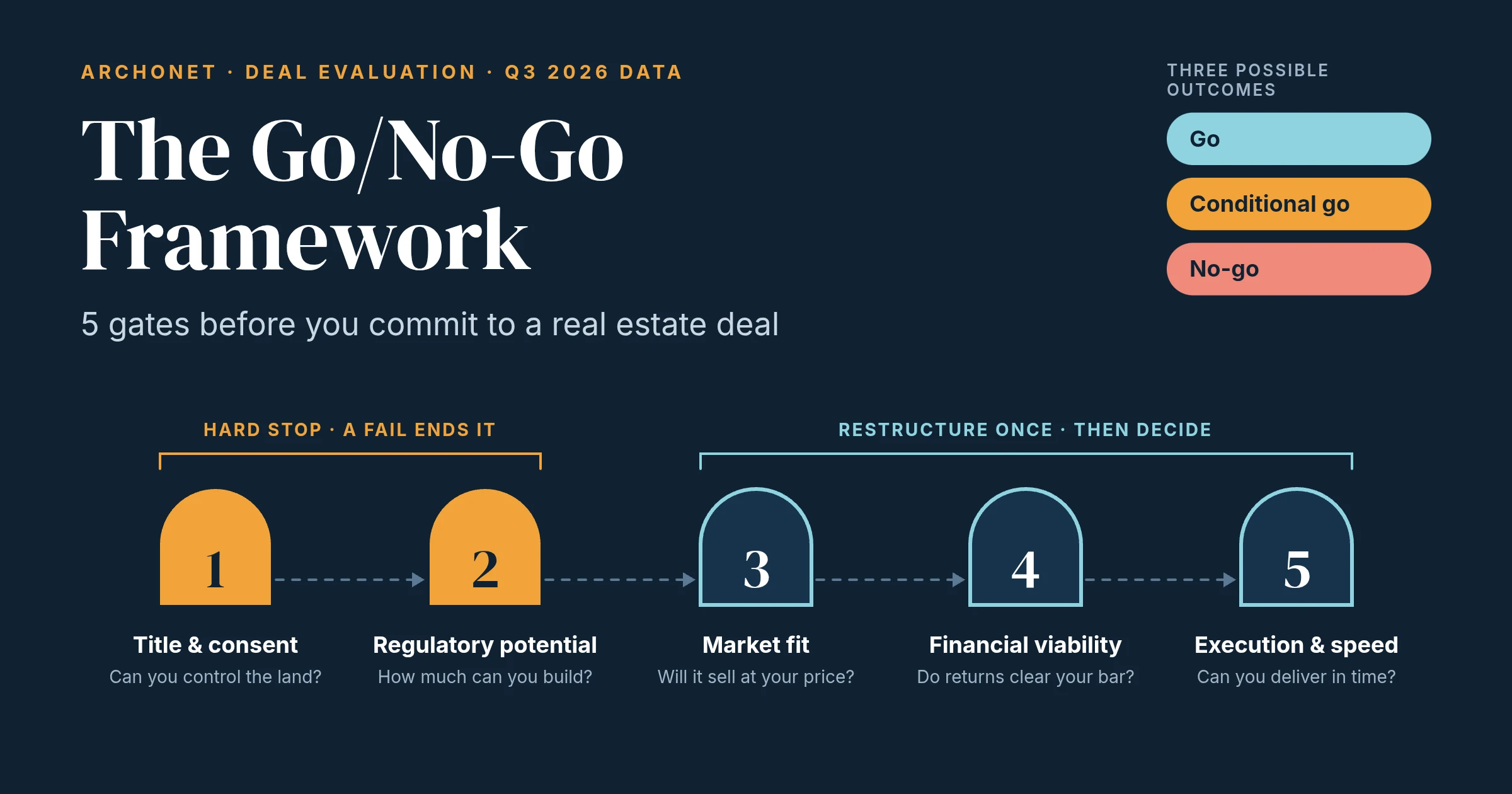
The five-gate go/no-go framework at a glance
The framework puts five questions in a fixed order, cheapest and most fatal first. Each gate ends in one of three results: pass, watch, or fail.
• Gate 1: Title, ownership and consent. Can you legally and practically control this land?
• Gate 2: Regulatory development potential. How much can you build, under which scheme, at what approval cost?
• Gate 3: Market fit and absorption. Will this product sell at your assumed price and pace in this micro-market?
• Gate 4: Financial viability. Do returns, peak funding and resilience clear your own thresholds?
• Gate 5: Execution, timing and speed. Can you deliver on this site, and decide inside the seller’s window?

The scoring rule is simple. Gates 1 and 2 are hard stops: a fail at either ends the evaluation, because no pricing or financing structure fixes land you cannot control or cannot build on. Gates 3 to 5 can often be repaired by changing the product mix, phasing or deal structure, so a fail there sends the deal back for restructuring, not straight to a no.
The final call is one of three outcomes. Go: every gate passes. Conditional go: no gate fails, and every watch has a named fix and an owner. No-go: any hard stop fails, or a restructured deal still fails.
One principle runs through every gate: set your thresholds before you look at the deal. A hurdle rate chosen after seeing the model is a justification, not a test.
Gate 1: Title, ownership and consent
Start here because it is the cheapest gate to test and the most fatal to fail. Nothing downstream matters if you cannot control the land.
Land title and encumbrance checks
Confirm clear ownership documentation, and surface encumbrances, litigation and reservations early. Your legal counsel owns this gate. Define in advance which findings are an automatic no-go and which are conditions that must be cleared before signing.
Redevelopment consent and stakeholder alignment
For redevelopment, the deal is also a people problem: committees, members and occupants must be aligned, and the selection process must be understood. A society that calls a meeting at short notice can compress your decision window, so know who decides, when, and on what evidence. This is legal and relationship work that software cannot replace, which is exactly why it comes first and runs in parallel with Gate 2.
Gate 2: Regulatory development potential
Development potential sets the ceiling on everything else. Revenue, cost per square foot and returns all depend on how much you can legally build, so this is where intuition is most expensive.
Compare applicable schemes under DCPR 2034 and UDCPR
A land parcel in Maharashtra can be eligible for more than one development scheme, and the best one depends on what you are optimising for: total FSI, the cost of that FSI, or the authority’s share. Start from the key land inputs: zone, ownership, plot area, road width, area under DP road and reservations. Then compare the schemes that apply, side by side, for greenfield (JV) and redevelopment cases. Mumbai-region land is governed by DCPR 2034, and the rest of the state by UDCPR.
Map FSI tranches and approval costs
Built-up area rarely comes from one source. Break your FSI into its tranches: basic FSI, other in-situ FSI, green building incentive FSI, premium FSI and TDR. Each has a different cost and availability, so the mix drives your economics. Then price the approvals line by line, from I/R conversion charges and scrutiny fees to LUC tax, so that approval cost enters the model as a number, not a footnote. Finally, compile the regulatory constraints that shape the design: building heights, setbacks, fire safety and parking requirements.
The kill test
Before you open a financial model, ask one question: does the best available scheme deliver enough saleable area, at an acceptable all-in cost of land, FSI and approvals, to be worth modelling? Decide the minimum in advance. If the answer is no, stop here. The deal has failed Gate 2, and the cost of finding out was a few minutes of analysis rather than weeks of feasibility work.
Gate 3: Market fit and absorption
A deal can pass every regulatory test and still fail because the product it produces is not the product the micro-market is buying. Gate 3 tests your sales assumptions against evidence.
Read the micro-market, not the headline
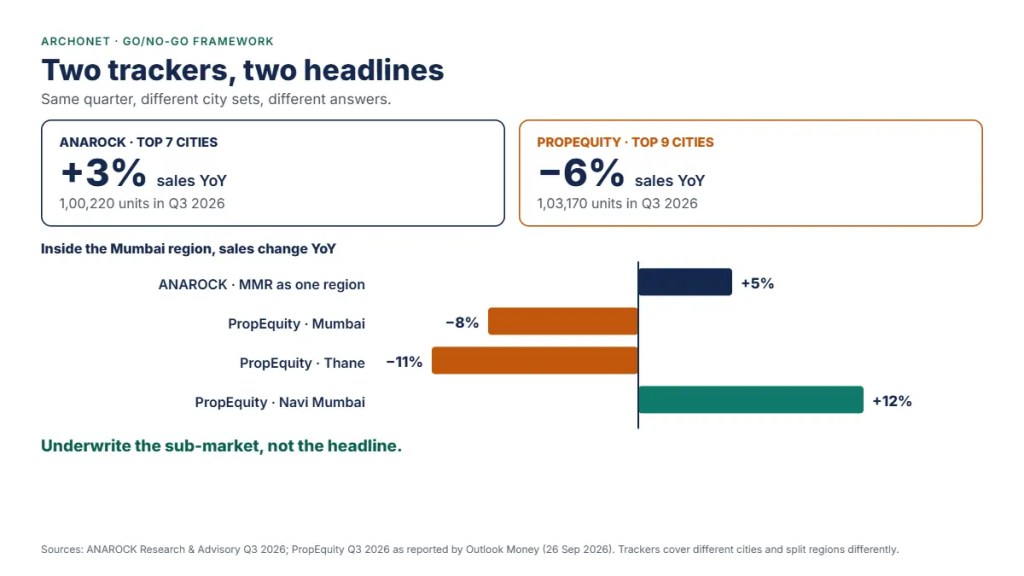
Headline numbers can point in different directions. Anarock reported housing sales across the top seven cities up 3% year on year in Q3 2026. PropEquity, which tracks nine cities, reported sales down 6% year on year, with Mumbai down 8%, Thane down 11% and Navi Mumbai up 12%. The two trackers cover different city sets, and even within one region, micro-markets moved in opposite directions. The lesson is practical: never underwrite a deal on a city-level headline. Underwrite it on the comparables, absorption and price points of the sub-market where your land sits.
Match your product mix to demand
Developer behaviour in MMR shifted notably in Q3 2026. According to Anarock, launches priced below ₹80 lakh made up 51% of MMR’s new supply, up from 39% a quarter earlier, while homes above ₹1.5 crore were 30%. Across the top seven cities, the affordable segment (below ₹40 lakh) rose to 14% of launches from 6% in the previous quarter. If your plan concentrates on a price band that competitors are crowding, or abandoning, your velocity assumption needs an explicit justification.

Stress-test your pace against the overhang
Anarock puts MMR’s average base selling price at ₹17,950 per sq ft (on super built-up area), up 4% year on year and 1% on the quarter. Its overhang of 19 months sits between Bengaluru at 15 months and Hyderabad at 28. Anarock’s own advice to developers is to match launch pace to realised sales velocity rather than to last quarter’s momentum. Apply the same rule to your deal: if the plan needs faster absorption than the micro-market is delivering today, mark Gate 3 as a watch, and either change the mix, phase the launches, or pass.
Gate 4: Financial viability
Gate 4 asks whether the deal pays you enough, for the capital and risk involved, on assumptions you can defend.
IRR, NPV and equity multiple against your hurdle rate
Model each product-mix iteration and read the returns together: IRR, NPV and equity multiple, phase by phase. Judge them against your own hurdle rates, set before you saw the deal. One metric alone misleads: a high IRR on a small base can sit beside an unattractive equity multiple, and the reverse.
Peak funding and DSCR
Returns do not tell you how much of your own capital the project will consume. Build a monthly cashflow, including loan payments, to find the actual out-of-pocket capital required until completion, and check debt service coverage (DSCR) where the project carries debt. A deal that clears its return targets but needs more peak funding than you can deploy is a fail at Gate 4, not a good deal waiting for capital. Anarock notes that borrowing costs are stable while input costs remain elevated, so test the cost side hard.
Sensitivity analysis
Then break your own model. Vary sale price, sales velocity and cost escalation, and find the single assumption that flips the decision. If a 5% slip in one input turns a go into a no-go, you have not found a robust deal. You have found a bet, and you should know that before the committee does.
Gate 5: Execution, timing and speed
The last gate tests whether the deal can actually be delivered and whether you can win it.
Timelines, approvals and delivery capacity
Map the full timeline from land acquisition to the sales phase, and check it against your team’s capacity and capital cycle. Execution record matters to buyers too: Anarock observes that track record is weighing more heavily on purchase decisions than in earlier cycles, which raises the cost of a delayed or poorly run project.
Decision speed
Archonet describes a scenario every MMR developer will recognise: “Mera project kisi aur ke calendar pe chalta hai,” or “my project runs on someone else’s calendar.” A society committee calls a meeting at short notice, feasibility is delayed, and by the time the numbers arrive the tender has been signed by someone else. A framework only helps if it runs inside the window the deal gives you. If your process takes weeks and the seller’s clock takes days, the failure is built into the calendar before the first number is run.
Turning five gates into one decision
Write the result on one page so the decision is visible and repeatable. For each deal, record: the gate, its result (pass, watch or fail), the evidence behind it, the owner of any open item, and the date it must close.
Then apply the rules without exception:
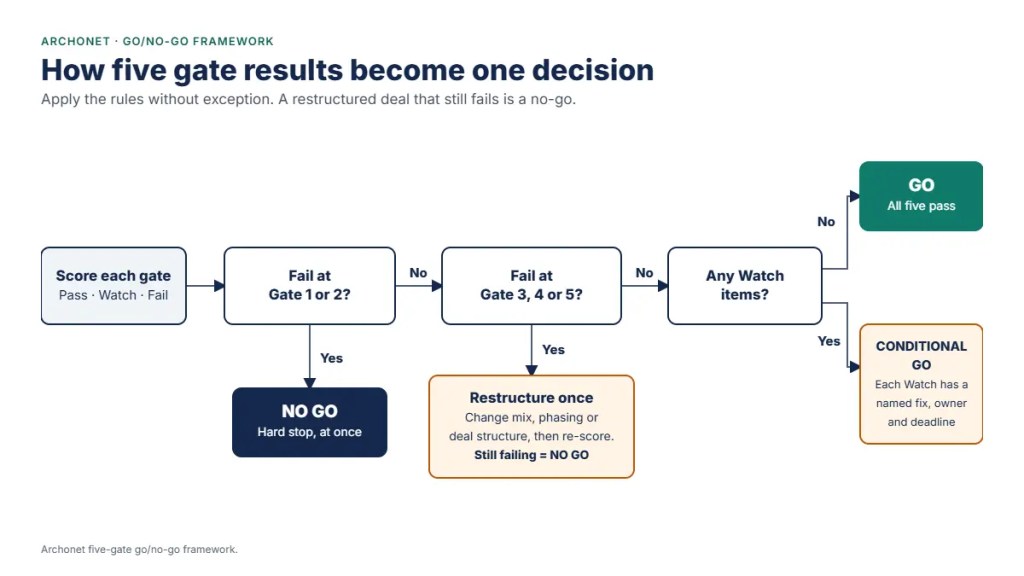
• Any fail at Gate 1 or Gate 2 means no-go, immediately.
• A fail at Gates 3 to 5 sends the deal back once for restructuring. If it still fails, it is a no-go.
• A conditional go needs every watch to have a named fix, an owner and a deadline.
• A go needs all five gates to pass on thresholds that were set before the evaluation began.
Keep the one-page record for every deal, including the ones you reject. Over time, the rejected deals teach you as much as the signed ones: which gate kills most of your pipeline, which assumptions you tend to overestimate, and where to spend your next hour of diligence.
How Archonet runs this framework in minutes
Archonet was built around this decision. Its two live products map directly onto the gates that need the most repeatable analysis.
LandWise is a land potential estimator for parcels in Maharashtra, based on DCPR 2034 (Mumbai region) and UDCPR. It covers Gate 2 and the technical side of Gate 4 with five outputs: a scheme comparison, a regulation summary, an FSI statement across tranches, an approval cost summary, and a potential summary designed to support a go/no-go decision. Inputs are entered in six steps, and the system flags errors when an input crosses a regulatory limit.
FinWise is a project cashflow forecaster that covers Gate 4. It optimises the unit mix, visualises timelines from land acquisition to sales, and reports IRR, NPV, equity multiple and DSCR for each iteration, with monthly cashflow and sensitivity analysis to test your assumptions.
Both tools let you save and refine inputs, test scenarios, and export PDF reports to share with partners, lenders and investors. Archonet states that this reduces analysis time from weeks to hours, and reports benefits of 10x analysis time saving, 5x more projects evaluated and 90% feasibility cost savings.
Two honest boundaries apply. Archonet does not replace legal diligence at Gate 1 or your local market knowledge at Gate 3: you still bring the title review and the sale price and cost assumptions. And LandWise currently covers land in Maharashtra only. Within that scope, it turns the slowest and most intuition-heavy gates into something you can run before the committee meets.
What is a go/no-go decision in real estate?
It is the formal decision to commit capital to a deal or walk away, made against criteria set in advance. A good one is based on evidence across legal, regulatory, market, financial and execution factors, not on a single metric or a first impression.
What should a real estate feasibility study include?
At minimum: development potential under the applicable regulations, an FSI statement, approval costs, a product mix, project timelines, monthly cashflow, return metrics such as IRR, NPV and equity multiple, and sensitivity analysis on price, velocity and cost.
How fast can a deal be screened?
That depends on the tools and the data on hand. Archonet states that LandWise produces a land potential summary, covering built-up area and financial analysis, in minutes rather than days.
Which metric matters most: IRR, NPV or DSCR?
None alone. IRR, NPV and equity multiple show return, DSCR shows debt serviceability, and peak funding shows how much capital you must commit. A deal should clear all of them against your own thresholds.
Decide before the calendar does
A framework earns its keep only if you can run it before the window closes. If you want to see all five gates, from FSI potential to monthly cashflow, applied to one of your own parcels, book a live demo with the Archonet team: Schedule a live demo. You can also explore LandWise for land potential and FinWise for project cashflow.