

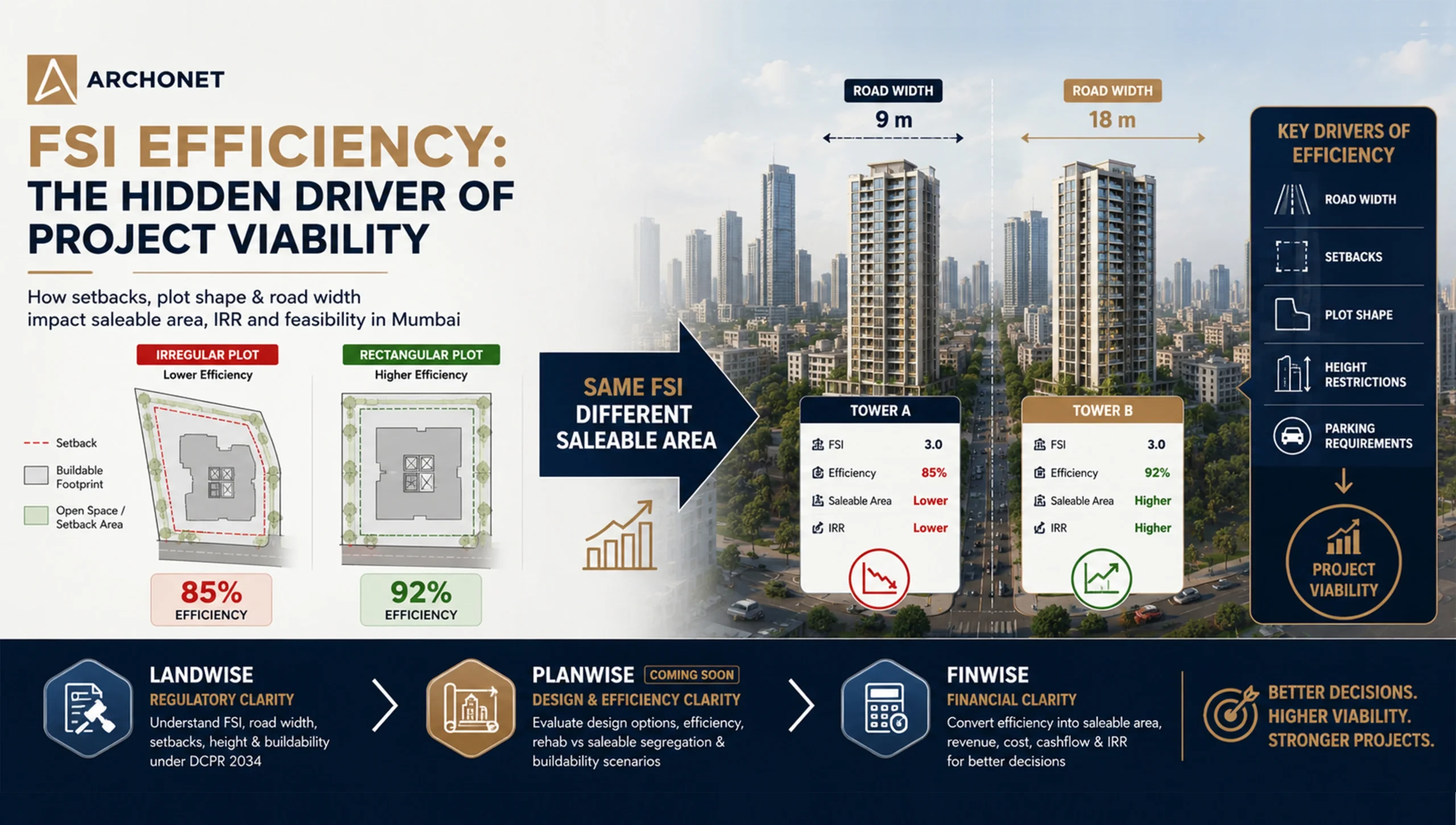
In Mumbai, developers spend enormous energy debating FSI, TDR, premiums, RR rates, and scheme combinations. But there is one factor that quietly determines more viability outcomes than all of these combined:
FSI Efficiency
Efficiency is the percentage of buildable FSI that actually converts into saleable area. Design efficiency is in general RERA Carpet divided by FSI Built up area (FSI BUA).
It is shaped not by finance or policy alone, but by geometry, setbacks, road width, and plot shape — the physical realities of Mumbai’s urban fabric.
Two plots with the same FSI potential can have wildly different saleable outputs, simply because one is more efficient than the other.
And in a city where land is scarce, premiums are high, and redevelopment dominates, even a 5–10% efficiency swing can change IRR by 1–2%.
This blog breaks down how efficiency works in Mumbai, why it varies so sharply across micro‑markets, and how developers can use regulatory intelligence to make better decisions.
1. Why Efficiency Matters More Than FSI
FSI tells you how much you can build.
Efficiency tells you how much you can sell.
A project with:
- 3.0 FSI and 85% efficiency
can be less profitable than a project with - 2.5 FSI and 92% efficiency.
Because in Mumbai, saleable area drives revenue, not FSI.
Efficiency impacts:
- Saleable area
- Construction cost per saleable sqft
- Parking design
- Unit planning
- IRR
- Cashflow timing
- Overall feasibility
This is why efficiency is the “silent killer” of viability.
2. Road Width: The First and Most Powerful Efficiency Driver
Road width determines:
- Permissible building height
- Setback requirements
- Fire tender movement
- Podium height
- Tower footprint
- TDR loading potential
In Mumbai, the difference between a 9m road and a 12m road can change:
- Buildable height
- Number of floors
- Efficiency
- FSI consumption
- Parking layout
- Saleable area
A 9m road may force deeper setbacks and limit height, reducing efficiency.
A 12m or 18m road can unlock taller towers with slimmer cores, improving efficiency.
Road width is often the single biggest determinant of whether a plot can support high FSI.
3. Setbacks: The Hidden Geometry That Eats Into FSI
Setbacks are mandatory open spaces around the building.
They depend on:
- Road width
- Plot size
- Building height
- Fire norms
- DCPR 2034 regulations
Setbacks reduce the buildable footprint.
A smaller footprint means:
- Larger core-to-floorplate ratio
- More circulation area
- Lower efficiency
A 10–15% increase in setbacks can reduce efficiency by 5–8%.
In redevelopment projects, where societies expect maximum rehab area, setbacks can make or break feasibility.
4. Plot Shape: The Most Underestimated Efficiency Variable
Mumbai is full of irregular plots:
- Triangular
- L‑shaped
- Tapered
- Deep and narrow
- Multiple frontages
- Encroached edges
Plot shape affects:
- Tower placement
- Core design
- Parking layout
- Rehab vs saleable segregation
- Ventilation shafts
- Fire tender access
A simple rule: The more regular the plot, the higher the efficiency.
A rectangular plot can achieve 90–92% efficiency.
An irregular plot may struggle to reach 80–88%.
This difference alone can swing IRR by 1–2%.
5. Height Restrictions: The Only Reason FSI Is Sometimes Left Unused
In Mumbai, developers never leave FSI unused — except when height becomes the limiting factor.
This happens in:
- Airport Influence Zones
- Coastal Regulation Zones
- Heritage precincts
- Narrow road corridors
When height is capped:
- TDR cannot be fully loaded
- Premium FSI may be limited
- Efficiency becomes even more critical
- Saleable area is constrained
In these zones, viability depends more on design intelligence than FSI availability.

6. Rehab vs Saleable Segregation in Redevelopment
Redevelopment introduces a unique efficiency challenge:
- Rehab area must meet minimum size norms
- Rehab wings often have deeper setbacks
- Rehab cores are less efficient
- Rehab floors may require additional fire norms
- Rehab and saleable must be segregated
This means:
- Rehab efficiency is always lower
- Saleable efficiency must compensate
- The blended efficiency determines viability
A redevelopment project with poor rehab efficiency can lose 8–12% saleable efficiency overall.
7. Parking: The Invisible Efficiency Drain
Parking requirements under DCPR 2034 can dramatically affect efficiency:
- Podium height
- Ramp placement
- Driveway width
- Turning radius
- Ventilation shafts
- Fire tender access
A poorly designed parking layout can reduce efficiency by 3–5%.
In high‑FSI projects, parking becomes a major design constraint.
8. Micro‑Market Efficiency Patterns Across Mumbai
Efficiency varies by geography because plot shapes, road widths, and urban form vary.
South Mumbai
- Narrow roads
- Height restrictions
- Irregular plots
- Heritage constraints
- Slightly Lower efficiency (85–88%)
- However, larger unit sizes help increase efficiency (88-90%)
Central Mumbai (Worli–Lower Parel–Dadar)
- Wider roads
- Taller towers
- Larger amalgamated plots
- Better efficiency (about 90%)
Eastern Suburbs (Chembur–Ghatkopar–Vikhroli–Mulund)
- Regular plots
- Good road networks
- Balanced setbacks
- High efficiency (90-93%)
Western Suburbs
- Highly variable
- Bandra/Juhu: irregular plots → lower efficiency (85-90%)
- Andheri/Goregaon/Borivali: regular plots → higher efficiency (90-92%)
Efficiency is a micro‑market signature — and it directly shapes viability.
9. Why Efficiency Has a Direct IRR Impact
Efficiency affects:
- Saleable area
- Revenue
- Construction cost per saleable sqft
- Premium FSI affordability
- TDR loading
- Cashflow timing
- IRR
A 5% drop in efficiency can reduce IRR by 0.8–1.2%.
A 10% drop can reduce IRR by 1.5–2.5%.
This is why efficiency is often more important than FSI itself.

The Archonet Perspective: LandWise → PlanWise → FinWise
Efficiency is not just a design detail — it is a regulatory and financial variable.
And in Mumbai, where every square foot matters, developers need clarity across three layers:
1. Regulatory clarity (LandWise)
LandWise helps developers understand the regulatory side of feasibility:
- What FSI is permissible
- How road width affects buildability
- How setbacks change the developable envelope
- Where height restrictions apply
- How much FSI can actually be loaded
This regulatory foundation is essential before any efficiency analysis begins.
2. Design & efficiency clarity (PlanWise — currently in development)
Archonet is actively building PlanWise, a design‑generation and efficiency‑evaluation engine that will launch in the next few quarters.
Once ready, PlanWise will help developers:
- Evaluate efficiency under different FSI options
- Compare tower placements and massing strategies
- Understand how setbacks, shape, and road width affect saleable area
- Model rehab vs saleable segregation
- Visualize buildability under multiple design scenarios
- Quantify efficiency differences instantly
PlanWise will become the layer that translates regulation → design → efficiency.
3. Financial clarity (FinWise)
FinWise converts efficiency into financial outcomes:
- Saleable area
- Revenue
- Construction cost per saleable sqft
- Cashflow timing
- IRR impact
- Sensitivity to efficiency changes
- Viability across multiple design options
FinWise ensures developers understand the financial consequences of every design and regulatory decision.
Final words
LandWise gives the regulatory truth.
PlanWise (coming soon) will give the design and efficiency truth.
FinWise gives the financial truth.
This is the decision‑intelligence stack Mumbai developers need to navigate complex redevelopment and high‑FSI environments with confidence.