

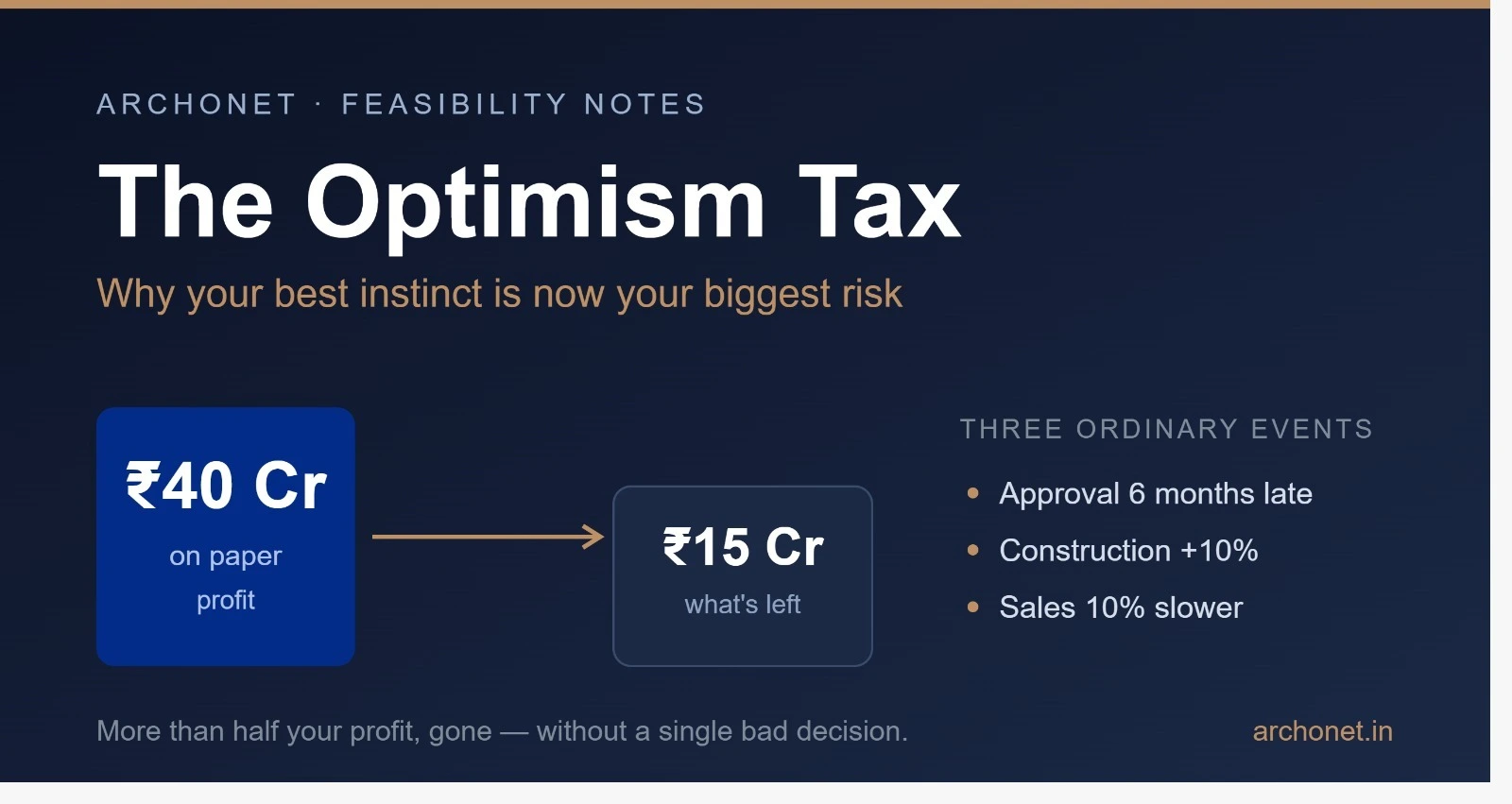
Why Your Best Instinct Is Now Your Biggest Risk
Feasibility mistake real estate developers make often stem from banking too heavily on optimism.
Mumbai’s most experienced developers rarely lose money because they’re wrong about the building. They lose it because they’re optimistic about everything around it — the timeline, the costs, the buyers. Here’s the quiet math of that optimism, and how to take it off the table.
A developer in Borivali once told me he could price a redevelopment plot in the time it takes to walk from the gate to the watchman’s cabin.
He wasn’t bragging. He’d done it a hundred times and been right most of them. Three decades of building does that — it compresses a thousand details into a single feeling in your gut. This works. This doesn’t.
For most of those thirty years, that instinct was enough. The trouble is that the market which trained it has quietly disappeared, and the instinct hasn’t noticed yet.
The gut isn’t lying. It’s just running on old prices.
Twenty years ago the math forgave you. Land was cheap, so your margin had a cushion. Approvals came in months. Construction costs barely moved. Buyers were waiting, so flats sold almost as fast as you could pour concrete.
In that world, a wrong guess cost you a little. You made slightly less, shrugged, moved on. Experience worked because there wasn’t much to get wrong.
That cushion is gone — and what replaced it is a peculiar, predictable kind of error. When developers estimate from memory, they don’t make random mistakes. They make the same mistake, in the same direction, every single time.
Feasibility mistake real estate developers make
They underestimate everything that costs money — and overestimate everything that makes it.
This isn’t a Mumbai problem or a real estate problem. Psychologists have a name for it — the planning fallacy — and it shows up everywhere humans forecast their own projects, from kitchen renovations to airports. We picture the version where things go right, because that’s the version we’re excited about. The delays, the cost creep, the slow quarters — those feel like bad luck that happens to other people’s projects.
Here’s what that bias looks like when you line up what the gut assumes against what the market actually delivers.

Notice the shape of it. Every bar on the “money out” side is taller than you expected. Every bar on the “money in” side is shorter. None of these are disasters on their own. A few months here, a few percent there. The gut waves each one off as a rounding error.
And that’s the trap. Because they don’t arrive one at a time.
Watch ₹40 crore become ₹15 crore — without a single bad decision
Forget the jargon. Follow one project.
You’re looking at a society redevelopment. Here’s the back-of-envelope version every developer runs in their head:
| THE DEAL, ON PAPER ₹190 Cr revenue − ₹150 Cr cost = ₹40 Cr profit Three years, start to finish. A clean number. Your gut says yes. |
Now let three completely ordinary things happen — the kind that happen on most projects, most of the time.
The approval lands six months late. Not a scandal. Routine, in a city where developers openly say it can take two years after the LOI just to clear approvals. But six extra months means six more months of loan interest, six more months of rent paid to displaced tenants, six more months of overheads ticking along. Cost: about ₹8 crore.
Construction comes in 10% higher. Steel moved. Labour moved. You did nothing wrong — the market did. Cost: about ₹5 crore.
Sales run 10% slower. With roughly 16 months of unsold flats already sitting across Mumbai, your inventory takes longer to clear. You either trim prices or hold and keep paying interest. Cost: about ₹12 crore.
Add them up.

More than half your profit — gone. And here’s the part that should keep you up at night: you didn’t make a single foolish call. Every assumption was reasonable on the day you made it. The damage came entirely from the fact that nobody asked what happens when three reasonable assumptions miss at the same time.
That’s the optimism tax. You don’t get a bill for it. You just quietly collect a smaller profit two years later and call it “the market.”
Read our blog on True cost of approval delays here.
The one question most feasibility checks never ask
Almost every feasibility a developer runs answers a single question:
“What happens if everything goes to plan?”
Which is the wrong question, because everything never does. The question that actually protects your money is the boring one nobody enjoys asking:
“…and what happens if it doesn’t?”
That second question is the entire difference between a gut call and a tested decision. Same instinct, same plot — but now you’ve stared at the downside before you signed, not after. Here’s the same project, pressure-tested one shock at a time.

Any single shock, you can absorb. It’s the bottom row that decides whether this was a good deal or a three-year favour you did for your bank and your contractor. And you’d want to know which one it is today — not on the day the last unsold flat is staring back at you.
This is not “trust the spreadsheet, ignore the veteran”
Let’s be clear, because this gets misread constantly. The fix is not to hand your judgment to a model. That’s just the same mistake pointed the other way.
A spreadsheet doesn’t know the corporator. It doesn’t know which society secretary can stall you for a year, or that buyers in this pocket have gone quiet, or the site quirk an experienced eye catches in thirty seconds. Your judgment sees all of that, and nothing replaces it.
But your judgment has one specific blind spot: it cannot add up delays, inflation, interest and slow sales all at once. No human gut can. That’s not a flaw in you — it’s how every brain handles compounding risk. We feel one problem clearly and three problems not at all.
So the sharpest developers split the job. Experience decides which plots are worth a serious look. Data tells you how much room for error each one actually has. Gut narrows the field; numbers pressure-test the finalist. In this market, neither one alone is enough.
Feasibility isn’t a cost sheet. It’s a decision.
Most people treat feasibility as paperwork — a document you produce after you’ve decided, to justify the deal. Flip it. Real feasibility is the decision itself: is this worth my capital, my next three years and my name, even if a few things go sideways? Done properly, it doesn’t just hand you a profit figure. It tells you how fragile that profit is.
The reason most developers skip it isn’t laziness. It’s time. Properly stress-testing a deal — checking different schemes, premiums, timelines, sales speeds — used to mean a week in Excel or waiting on a consultant. So the deal moved at the speed of the gut, and the second question never got asked. Which is exactly where the expensive surprises hide.
That gap is the reason Archonet exists.
| LandWise — regulatory feasibility, in minutes What can I actually build here, and under which scheme does it pay best? LandWise compares the DCPR schemes applicable to your plot, calculates buildable area, premiums and approval costs, and shows you the most profitable path — in minutes, not weeks. |
| FinWise — financial feasibility and scenario stress-testing Does it still work when things go wrong? Feed in your basic numbers and FinWise gives you the full picture: profit, IRR, month-by-month cashflow, and the sensitivity scenarios. Change the price, the timeline, the sales speed — and watch your profit move in real time. That ₹40-crore-to-₹15-crore slide? You’d see it before you sign, not after. |
The point was never fancier software. It’s that you finally get to ask the second question — the one that protects your money — without surrendering the speed your instinct gives you.
The bottom line
The developers who win the next decade in Mumbai won’t be the ones who threw away their experience for a dashboard. And they won’t be the ones still pricing plots from the watchman’s cabin while the market quietly changes the rules underneath them.
They’ll be the ones who do both — trust the gut to spot the opportunity, then trust the numbers to tell them how much room for error it really has.
Your experience got you this far. In this market, a few honest numbers are what carry it further.
See your next plot under pressure Run one of your live deals through LandWise and FinWise before you commit.
archonet.in · Book a walkthrough
All figures are illustrative and directional, drawn from publicly reported MMR market patterns (approval timelines, construction-cost inflation, unsold-inventory levels and the gap between asking and registered prices). They demonstrate the analytical discipline, not a recommendation on any specific project. Always run your own deal-level feasibility before committing capital.
Sources & References
Industry Reports & Market Research
ANAROCK Research (Q2 CY 2025) MMR Residential Market Update Analysis of Mumbai Metropolitan Region housing inventory, absorption rates, and market trends. Source: anarock.com
JLL India (2025) India Construction Cost Guide 2025 Benchmark data on construction cost escalation, material pricing, and industry inflation trends. Source: jll.com
Turner & Townsend (2025) Global Construction Market Intelligence Report 2025 Global and Indian construction cost trends and inflation benchmarks. Source: turnerandtownsend.com
Knight Frank India (2025) Insights presented at the Mumbai Redevelopment Summit 2025 on redevelopment activity, project delays, and housing society redevelopment trends across MMR.
PropEquity (Q4 2025) Housing Sales Performance Report Residential sales trends across India’s major cities, including Mumbai Metropolitan Region. Reported by The Realty Today.
Redevelopment & Approval Timelines
Construction World (2025) Mumbai Redevelopment Summit 2025 Coverage Industry commentary from leading developers and consultants on redevelopment approval timelines, project execution challenges, and redevelopment bottlenecks in Mumbai. Source: constructionworld.in
Property Market Data
99acres (2025) Property Rates & Price Trends – Mira Road East and Borivali West Market pricing analysis based on listings and registered transaction data from IGR Maharashtra. Source: 99acres.com
Research on Planning & Decision-Making Bias
Kahneman, Daniel & Tversky, Amos (1979) “Intuitive Prediction: Biases and Corrective Procedures” Foundational research on forecasting errors and cognitive biases in decision-making.
Flyvbjerg, Bent (2021) “Over Budget, Over Time, Over and Over Again” Project Management Journal. Analysis of more than 2,000 capital projects examining cost overruns and schedule delays.